The Holiday ‘Season’ Schedule

by Bob Sparrow

onions2

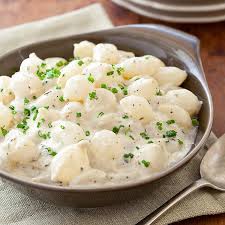
Creamed Onions – YUCK!

When I was growing up, back when the earth was still cooling, there was no such thing as a ‘Holiday Season’ – there was Christmas. Thanksgiving was when Jack, Suz and I, had to get ‘slicked up’ and go to our aunt and uncle’s house and eat creamed onions and turkey that was cut so thin that it only had one side. New Year’s was a non-event that meant Christmas vacation was nearly over and we’d soon be headed back to school.

Things have changed a bit since then; with the coming of television, the ‘Christmas Season’ was created and subsequently commercialized.  More recently, with the advent of political correctness, the ‘Holiday Season’ was born, to make sure we weren’t excluding anyone from the season’s buying bonanza.
holiday2

Unoffensive holiday symbols

  The way I see it, it’s a five-game ‘season’ where first, everyone gets on their game uniform for the ‘kick off’ at Halloween, followed by Veteran’s Day (which apparently is a non-league game), then into the meat of the schedule with Thanksgiving and Christmas and concluding with the ‘finals’ on New Year’s Eve.

So let’s look at the ‘season’, game-by-game.
mask2

Cheery Halloween mask

Halloween

How it started: It was originally an ancient Celtic religious celebration where they would bless and convert Pagans.

What happened? We took the religion out of it and now we just try to scare the bejesus out of kids with ugly masks and scary movies, while we bless and convert non-diabetics to diabetics with a sugar over-load. The American Dental Association also thanks you!

Veteran’s Day

vets

AMEN!

How it started: In 1919 Armistice Day was created marking the end of World War I on the 11th day of the 11th month at the 11th hour. In 1938 Armistice Day was declared a legal holiday and in 1945 it was changed to Veteran’s Day to recognize and celebrate all veterans.

What happened? Years ago Veteran’s Day was just a scrimmage, but fortunately, it’s become a little more celebrated in recent years, possibly due to the numerous conflicts we’ve put our brave men and women in armed forces through, but it’s still no Halloween! Personally, I’d eliminate Halloween and put greater emphasis on this holiday by having kids dress up like veterans and seek out service families and veterans to ask if they can help them in any way. Schools could ask their students to write a letter to someone in the armed forces to thank them for their service, but don’t count on it replacing the sanctity of Halloween anytime soon.

Thanksgiving
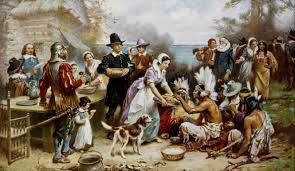
Tday

“Sorry about taking your land”

How it started: The Pilgrims wanted to celebrate a bumper crop year as well as show their benevolence toward the Native Americans, specifically the Wampanoag tribe, by inviting them to a feast and tossing them a drumstick after they vanquished them and took their land. OK, maybe they didn’t just take it; they did give them $24 worth of beads and trinkets for Manhattan. Subsequently the Wampanoag tribe suffered an epidemic, thought to be smallpox brought over by the English, which helped them establish their settlements. Years later, the King Philip’s War resulted in the deaths of 40 percent of the tribe. Most of the male survivors were sold into slavery in the West Indies, while many women and children were enslaved in New England.

What happened? Well, wouldn’t you continue to celebrate such a joyous occasion? We do, with a feast of turkey, dressing, cranberry sauce and pies of various fruits and nuts on Thursday and when the ladies realized that the men were spending the rest of the weekend watching football, they said, “Ladies let’s go shopping!” and thus ‘Black Friday’ was created. But even with its calorie-busting meals, football overload and guerilla combat shopping, Thanksgiving still has the redeeming quality of bringing families together – and that’s a good thing!

Christmas
Xmas

Remember Christmas?

How it started: The first recorded date of Christmas was in 336 AD (No, I wasn’t there!); a few years later, Pope Julius I officially declared that the birth of Jesus would be celebrated on the December 25th.  Although with shepherds in their fields at the time of the birth, it probably wasn’t in the winter at all.

What happened? Because this is the big cash cow of the season, the decorations and carols start in late October and continues through New Year’s Eve and beyond; it’s the ‘Big Game’. Yes, it’s been commercialized almost beyond recognition, but if you work at it, you can still find or better yet, create the ‘spirit of Christmas’, by helping those less fortunate or just experiencing a young child’s unbridled enthusiasm when they see that Santa hasn’t forgotten them. So work at finding the ‘spirit’ this year, as Vince Lombardi once said, “Giving isn’t everything, it’s the only thing!”  OK, maybe I made that up.
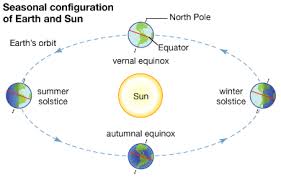
vernal

When do you want the new year to start?


New Year’s Eve

How it started: The year had to end sometime!

What happened? When the year really ends is a long story involving various calendars, but suffice it to say that historically a bunch of politicians and church folks have moved the start of the year around since the beginning of time, mostly just to suit their purposes. So don’t get too fixated on December 31st as the end of the year, it was originally the vernal equinox (around the end of March) and it could go back there if it will make someone some money or get someone elected.  No matter what the date, it’s always the time of year when we lie to ourselves about improving our lives ‘next year’ with some unrealistic resolutions.

This Thursday will mark the halfway point in the season, so relax and enjoy the ‘halftime show’ – it’s usually at the ‘kid’s table’.

Happy Thanksgiving!
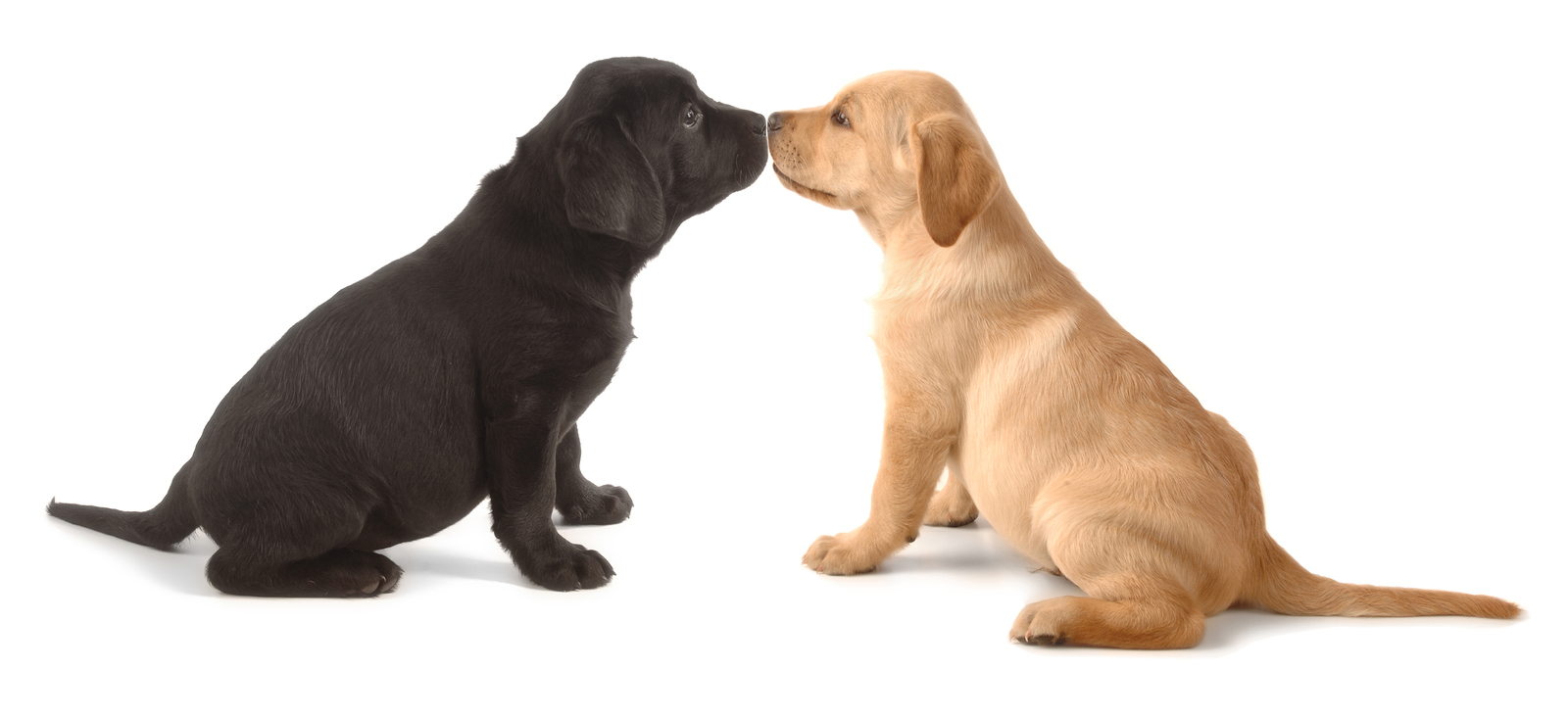
SPEED SNIFFING

By Suzanne Sparrow Watson

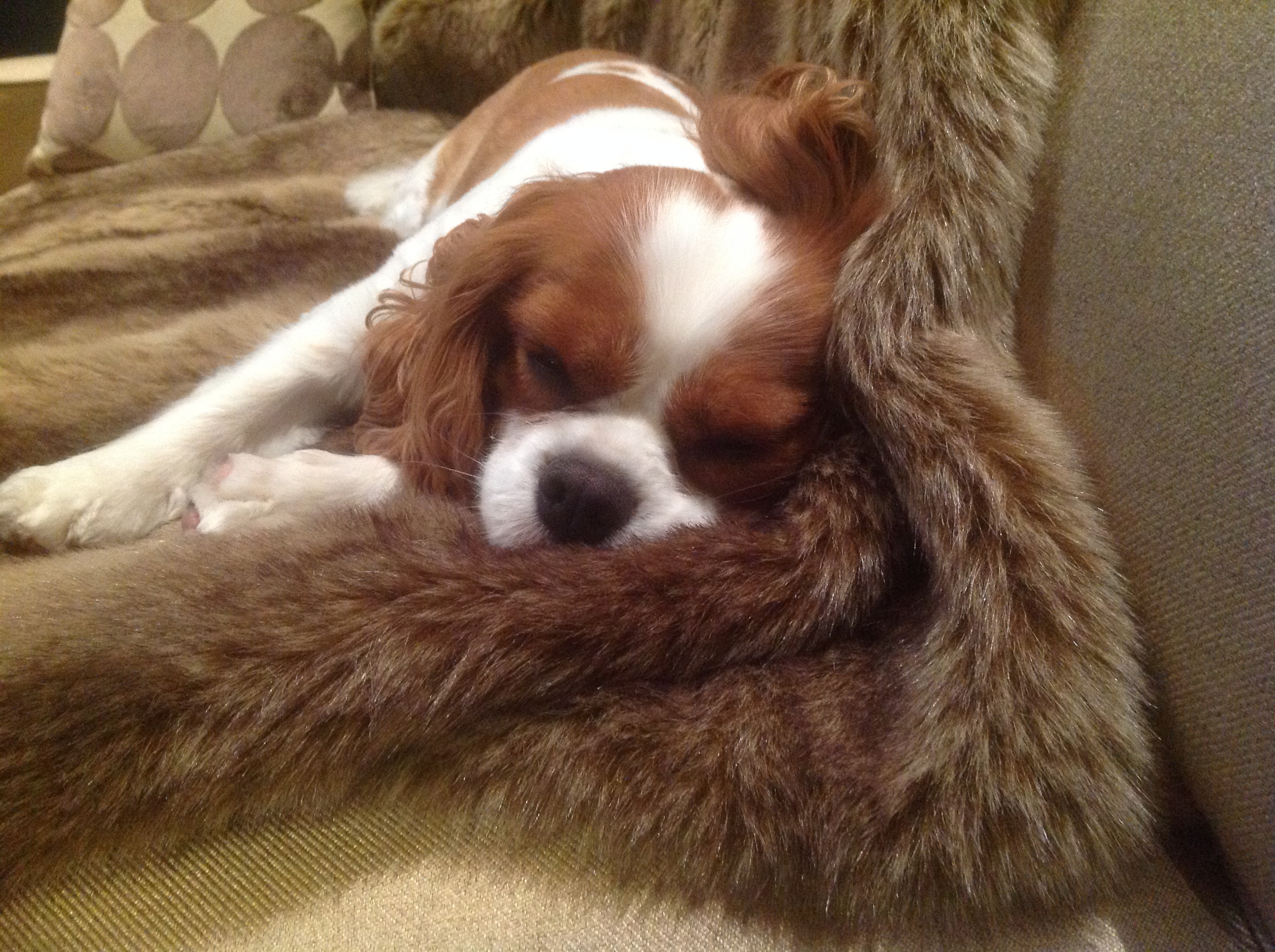
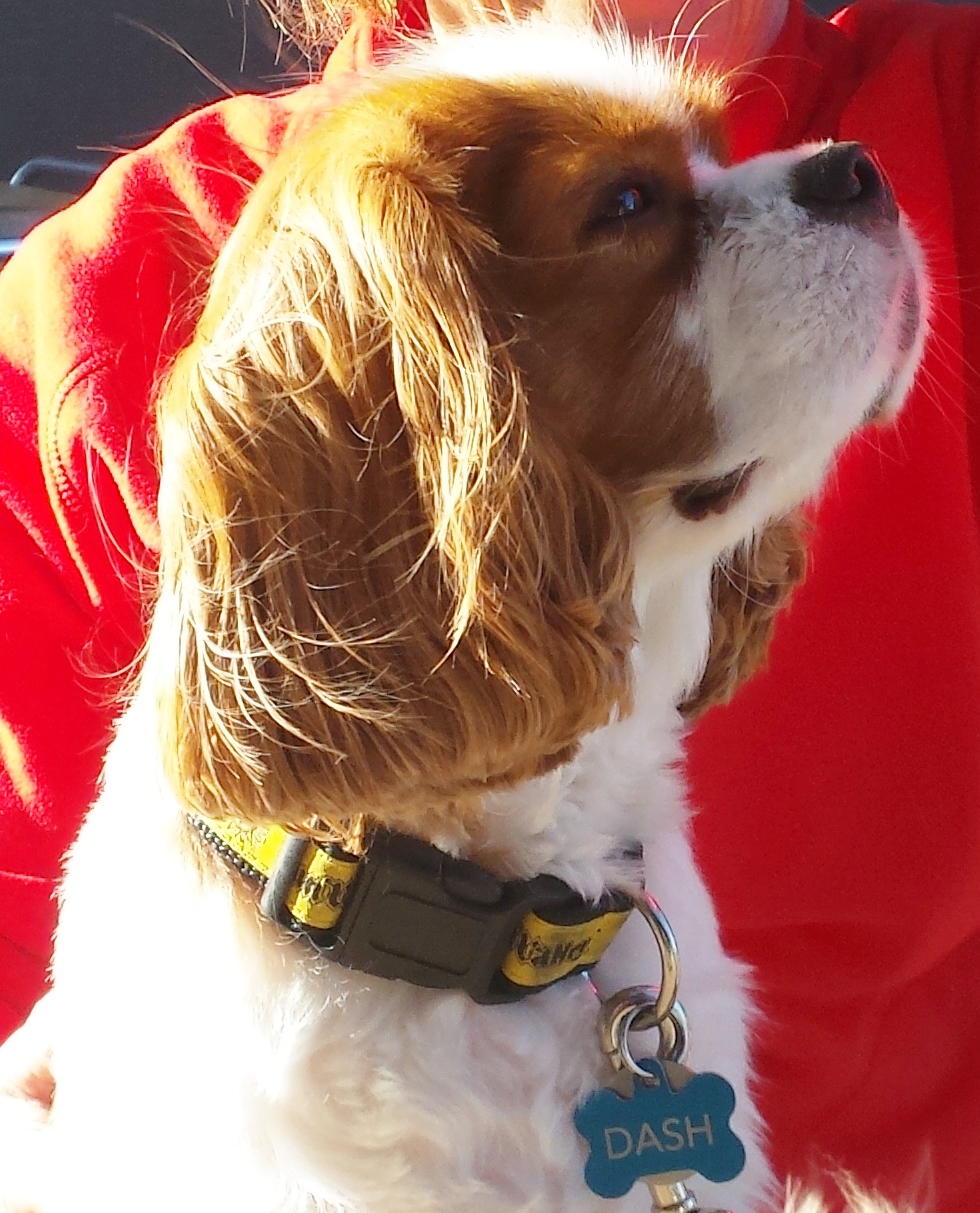
Dash, doing what he does best

Dash, working hard

This is a special day in our house – Dash the Wonder Dog was born three years ago today.  It seems like just yesterday that we brought him home…and that we had a life.  Since he adopted us our every waking moment has been devoted to his care, feeding and entertainment.  As you can see from the picture (left) his job is to lie contentedly on the couch and be cute; our job is to fawn over him.  My husband, who was adamantly against getting a dog for the past 25 years, will now not leave Dash alone for more than four hours at a time.  Golf games have been sacrificed so he can stay home with the dog. He makes me feel like I am Joan Crawford if I schedule activities that take me away during the day AND at night.  Next he’ll be accusing me of using wire coat hangers.  Truth be told, it’s been a great three years and as I reflect on  what we’ve learned from dog ownership it boils down to a few good lessons.

The sniff test

The sniff test

First  – we humans could learn a lot from dogs about assessing new people.  We usually utter something like “the jury is still out” when asked about someone recently met.  We pause, we take our time in forming an opinion, we seek advice from others.  Dogs, on the other hand, get right to the heart of it. They sniff butts.  One good whiff can tell them if the new acquaintance is friendly, sociable and what they had for dinner last Tuesday.  They make instant judgements that I’m fairly certain are right on the money.  The scene at our local dog park is like watching speed dating – one good sniff and the dogs either form a friendship or move on.  I’m certainly not suggesting that we sniff butts, although it might be as illuminating a way to pick a President as our current debate system.  But I do think that dogs are on to something – we should trust our initial impressions.  Usually our gut is a pretty good predictor of who we might want to be friends with and who is to be avoided like Louisiana in July.

Elizabeth Brown

Elizabeth Brown and Dash

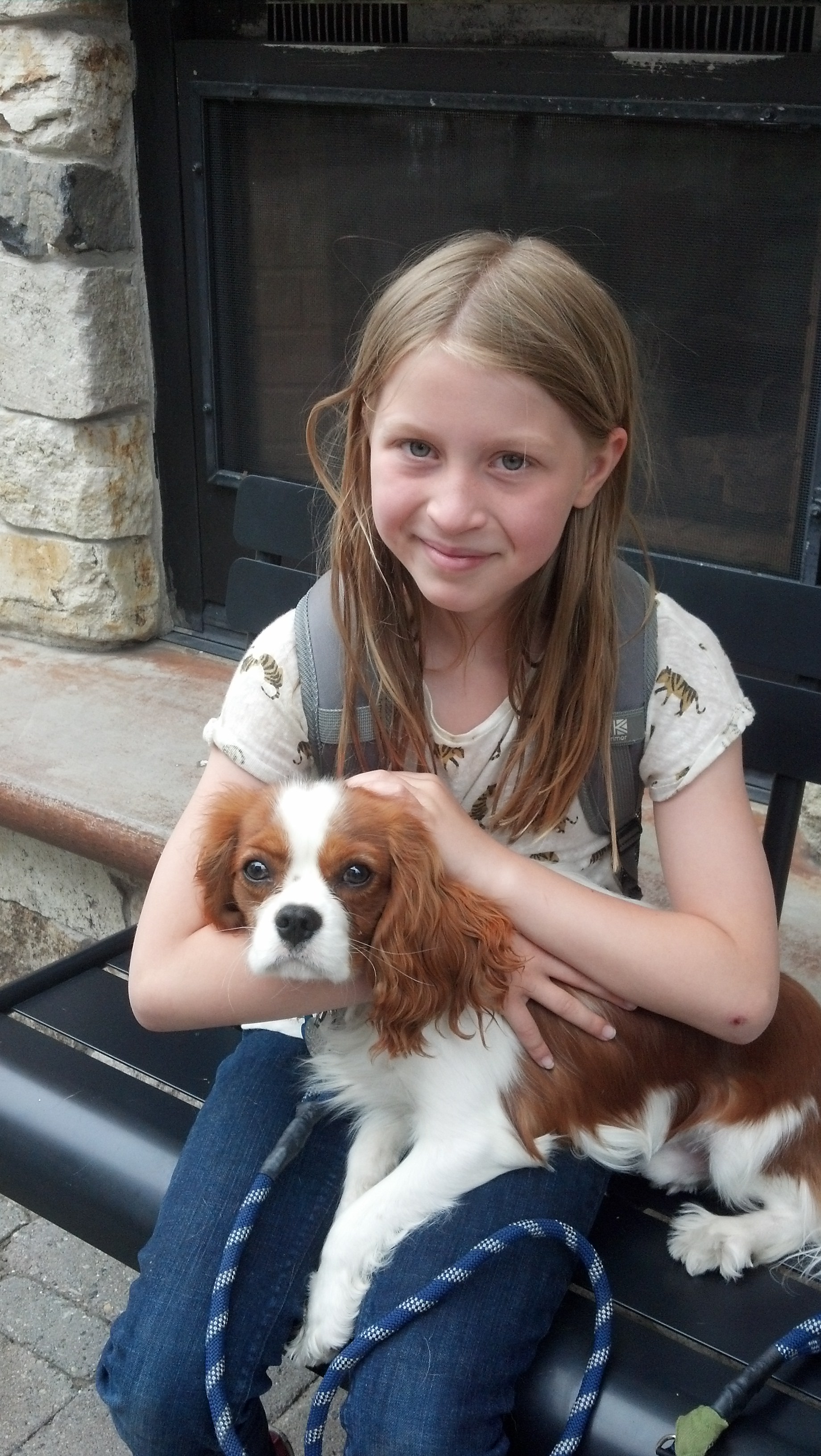
Second – we have been amazed by the people we have met just because we have a dog.  Every time we take Dash out, which is often, people stop to pet him and talk with us.  In fact my test for whether I would want someone as my friend is not the sniff test but whether they smile when they see Dash.  People who walk right by or who, worse yet, go out of their way to avoid him, would definitely not make my Christmas card list. But other dog owners in particular do stop and while the dogs are sniffing, we generally have some short conversation about how great our dogs are.  We commented last month after one such encounter up in Mammoth Lakes that we have met so many nice people because of Dash.  And even though some of the conversations are very short, the cumulative effect is that our lives are happier because of them.  One that particularly stands out is Elizabeth Brown, who we met in Tahoe two years ago.  She was visiting from England with her parents and grandmother.  She was bored to tears (as she told us) until she saw Dash.  She was so excited to hold him that she asked if she could have her picture taken.  We made sure she asked her parents for permission since we didn’t want to end up on the Sexual Predator list in our neighborhood, and once that was granted we snapped the picture (above).  I know that Dash made her trip more enjoyable and to this day we smile when we see the photo.  We can thank Dash for hundreds of small meetings that have truly enriched our lives.

A true friend

A true friend

Finally, I harken back to a phrase that I heard 30 years ago when I had a cute little mutt – “Lord, let me be the person my dog thinks I am.” It goes without saying – and every dog owner knows this – that there is nothing like the unconditional love of a dog.  Really, most of the time I don’t deserve the excitement Dash expends when I walk into the room. We all could probably take note from canine behavior – always happy, intuitive to every emotion, kisses on command, and loyalty.  The other day I was in our local pet shop and they had a new supply of the Life is Good tee shirts – the ones with cute dogs and great slogans.  My favorite was “Be Your Dog”.  There’s not a chance I can be that good, but surely it’s a worthy goal.

Since this is my last post before Thanksgiving I’d like to take a moment to thank all of our subscribers and wish each and every one of you a very Happy Thanksgiving.  We truly appreciate your continued support of our weekly attempts to entertain.


THE SOUND OF THE CITY

By Suzanne Sparrow Watson


The Golden Gate

The Golden Gate

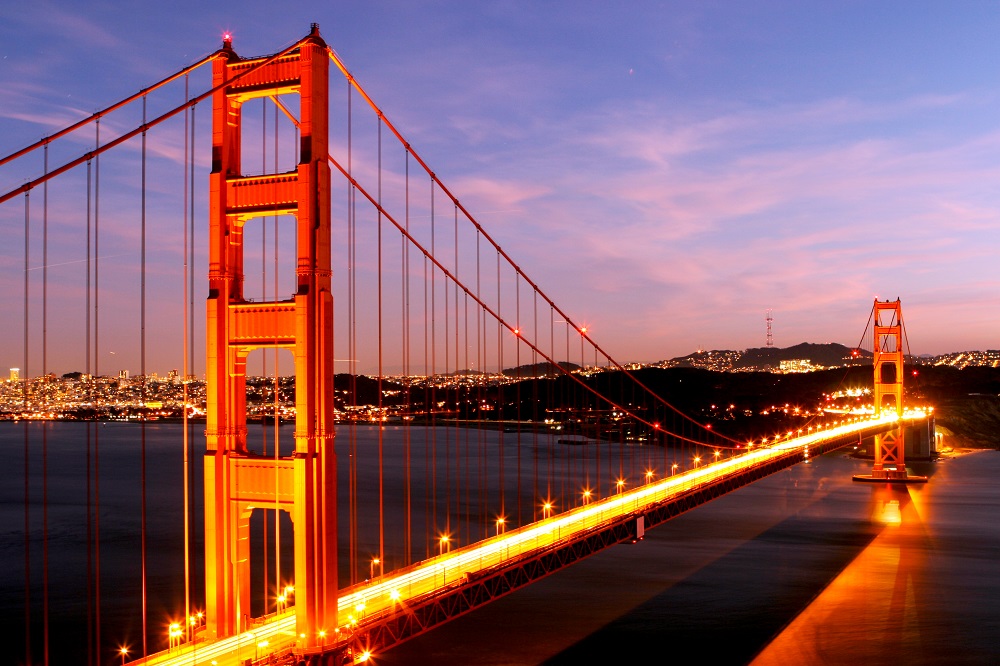
Our ancestor, Joseph Billiou, first ventured to Northern California in 1856, long after the gold rush had peaked and the “easy money” was gone.  Thus creating the family motto:  “Always a day late and a dollar short”.  Despite failing to make his fortune, Joseph set down roots and our family became one of the lucky ones who could call the Bay Area “home”.  To us, and most other families in the region, San Francisco was the centerpiece of cultural, sporting and culinary experiences. I was also fortunate enough to earn a living in the Financial District for more than 20 years.  San Francisco has always had a unique vibe – welcoming people with divergent backgrounds and talents while maintaining a sense of unity and cohesiveness.  But it would appear “The City” is changing, in large part due to a 2011 decision by the supervisors to offer generous tax breaks to any tech company willing to relocate to San Francisco.  As a result, the companies are gobbling up real estate to establish a presence there.  Thousands of “techies” are moving to the area for work.   The result is that the housing market, which has always been expensive, is now downright ridiculous.  New condos are going up in some of the older, “less desirable” neighborhoods which has resulted in evictions of people who have lived there for generations.  And to add insult to injury, there is no affordable place for them to go.  San Francisco, it would seem, is on the brink of reaching Venezuelan levels of wealth inequality.  In the past four months I’ve seen three documentaries covering the changing dynamics – all of them were depressing.   After watching the last one I became nostalgic for the city that once was.  And for some reason, I thought about the song that was an anthem for San Francisco for more than 30 years – “The Sound of the City”.

KSFO in its heyday

KSFO in its heyday

The song actually wasn’t a song at all.  It was the jingle for what was then the powerhouse radio station in the region – KSFO.  From the late 50’s until the early 80’s the station was owned by the singing cowboy, Gene Autry, and was billed as “The World’s Greatest Radio Station.  Particularly in San Francisco”.   In those days San Francisco had five TV stations and AM radio to cover news, sports and entertainment.  Autry quickly maximized his crown jewel by hiring a Murderer’s Row of disc jockeys:  Don Sherwood, Jim Lange, Del Courtney, Jack Carney and Al “Jazzbeaux” Collins.  Autry negotiated broadcasting rights with the 49ers and the Giants and had two legends, Lon Simmons and Russ Hodges, call the games.  Back then TV and radio stations had the good sense to sign off for a few hours in the wee hours of the morning and Autry wanted a jingle to use as the station went dark each night.  So in 1960 he commissioned the multi-talented Johnny Mann to write one for him.  When the song was first aired people thought it had been recorded by the Four Freshman, but in fact it was sung by eight studio singers in Hollywood, the most famous of whom went on to be the voice of Tony the Tiger.  The result was a beautiful masterpiece: the Sound of the City .  When you click on the link you will hear a lyrical song, reminiscent of a softer time when fun and bonhomie reigned supreme.  It is now the ringtone on my phone and each time I play it for a native of the Bay Area the person becomes misty-eyed.

The inimitable Don Sherwood

The inimitable Don   Sherwood

How did a song – and a radio station – become so ingrained in our psyches?  Well for starters, as I said, our entertainment choices were pretty limited.  But more importantly it is estimated that two-thirds of people living in the Bay Area during the 1960’s tuned in to listen to the bibulous Don Sherwood every weekday morning.  He was the Pied Piper of the Bay Area, with his throaty, cigarette-tinged chuckle that made even his reading of a Yami Yogurt commercial sound just the slightest bit dirty.  Each morning people gathered around the water cooler or the gym locker to talk about what prank Sherwood had pulled off during the morning commute.  That’s assuming, of course, that he had even bothered to show up for work.  A native-born San Franciscan, he was the product of two alcoholic parents and suffered from the disease himself.  It was a crapshoot each morning as to whether Mr. Sherwood was “not feeling well” that day.  But his show was so popular that even on the days he didn’t show up for work, his sidekick Carter B. Smith garnered higher ratings than the competitors.  Sherwood’s manic personality was hard for management to control and his wisest bosses never tried to make  “Donny Babe” conform.  After all, part of his appeal was his irreverent humor and his running gags.   No idea was too outrageous.  He once instructed everyone to crank down their car window and turn the radio up full blast.  He then broadcast the blare of a police siren.  Law enforcement reported a spike in fender-benders that morning but the gag had everyone laughing for weeks.  On another occasion he told drivers that on his command they should all turn left.  That stunt created havoc all over the Bay Area, particularly for the foolhardy souls who were crossing the Golden Gate Bridge at the time.  In 1961, when he challenged the young Jim Lange to a foot race from Stinson Beach to the Ferry Building in downtown SF, more than 60,000 people lined the route.  What was the attraction?  It was because KSFO, and Sherwood in particular, made people feel like they “belonged” to a community, regardless of their socioeconomic status.

The recent documentaries I watched report that San Francisco is becoming the epicenter of the “sharing” economy.  Which is somewhat ironic given that every picture I saw of the new “techies” featured them with headphones stuck in their ears, eyes cast downward at their phones, oblivious to the people and culture around them.  San Francisco has always been a city that changes and evolves but personally, I’ll take the “sharing” of 50 years ago – outstanding radio, a beautiful song and every once in a while, everyone turning left.

THE DROUGHT AND THE JUNE LAKE LOOP

By Suzanne Sparrow Watson

mammothYes, it’s me again this week.  As you read this my brother is hiking Machu Picchu.  Which means he has no access to the internet.  This could be my opportunity to write something really awful about him, except that he’s a really good guy and right now I’m just hoping he has a really great time.  So instead, I’ll write about my recent trip to June Lake Loop and the ravages of the California drought.

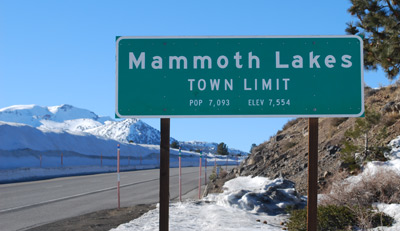
For those of you who live in Southern California you are probably familiar with Mammoth Lakes, a renowned ski town and home of several Olympians.  It is a place that my husband has visited yearly since 1960 and we have been going there together since the mid-80’s.  As someone who grew up going to Lake Tahoe,  I always considered “the Lake” to be the most beautiful mountain retreat in the Sierras.  And truly, it IS spectacular. But there is something about the eastern escarpment of the Sierras around Mammoth Lakes that takes your breath away.  Rather than the gently sloping foothills that you see on the western side, the eastern stretch juts out at a sharp angle from the flat terrain.  Mammoth is also higher than Tahoe – the town sits at about 7800 feet and the top of the mountain (which I have been crazy enough to ski down) is at a staggering 11,000 ft.

The Aptly named "Oh" Ridge

The Aptly named “Oh” Ridge

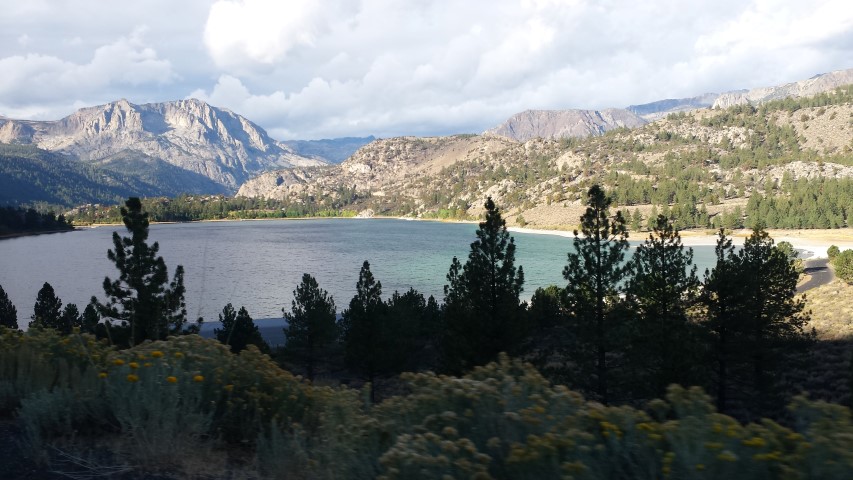
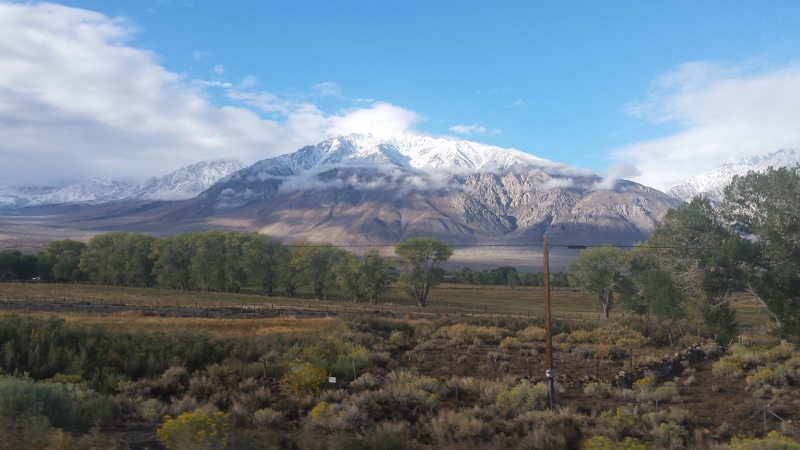
When we travel there in the summer we usually make a point of driving the June Lake Loop, a five-mile stretch of Highway 158 that is approximately mid-way between Mammoth Lakes and Lee Vining.  The loop is literally a horseshoe-shaped road that sits between the eastern Sierras and the four lakes that rim the road: June, Gull, Silver and Grant. Six hundred and twenty-nine brave souls live along the shores of the loop as permanent residents, but the population swells to thousands during the summer and fall.  It is the ideal place for fisherman, backpackers and day hikers.  They also have added a new spa which is attractive to people like me who leave their siblings to do the “outdoor” stuff.  This year we made the trip again, partly to see how the drought had affected one of our favorite spots.  As we entered Highway 158 coming north from Mammoth Lakes the first site we came is Oh! Ridge.  As you can see from the picture (right) the ridge earned its name.  I can’t remember a time when upon coming to that point I didn’t say “OH!”.  This picture was taken from my car window as my husband was trying to avoid the jerk driver behind us who was tailgating.  So you can imagine just how gorgeous the picture would be if we had actually stopped.  Still, you get the idea.  Although we had been reading a lot about the California drought, and June Lake was definitely down from previous years, it still looked pretty good.  A bit past the ridge we entered the village of June Lake, the hub of the loop.  It is where most of the population lives, where the businesses are and is adjacent to the June Mountain ski area, a favorite of locals.  There are several good little motels and best of all, an ice cream store.

Gull Lake is a litter harder to see from the roadway but sports its own marina and is a great place for fishing.  A mile down the road is the beautiful Silver Lake.  It is situated such that it often has a reflection of the mountain on the water and is another breathtaking site.  Unfortunately we were there on a cloudy day so it wasn’t showing its best side to us but is beautiful none the less.  I always have a soft spot in my heart for the only business on the lake, the Silver Lake Resort and Café.  It has been in business since the 1920’s, making it one of the oldest recreation resorts in the Sierras.  Make no mistake, “resort” is stretching the term a bit.  It is the type of place that sells everything from tee shirts to fishing lures at the check-out counter.  But back in the late 80’s when we embarked on this trip I had had a few too many…coffees.  There wasn’t a proprietor in June Lake who would let me use a restroom.  But the kind owners of the Silver Lake Resort saved the day, and my bladder, and I will always be grateful.  Again, Silver Lake looked a bit recessed but not alarmingly so.

The depleted Grant Lake

The depleted Grant Lake

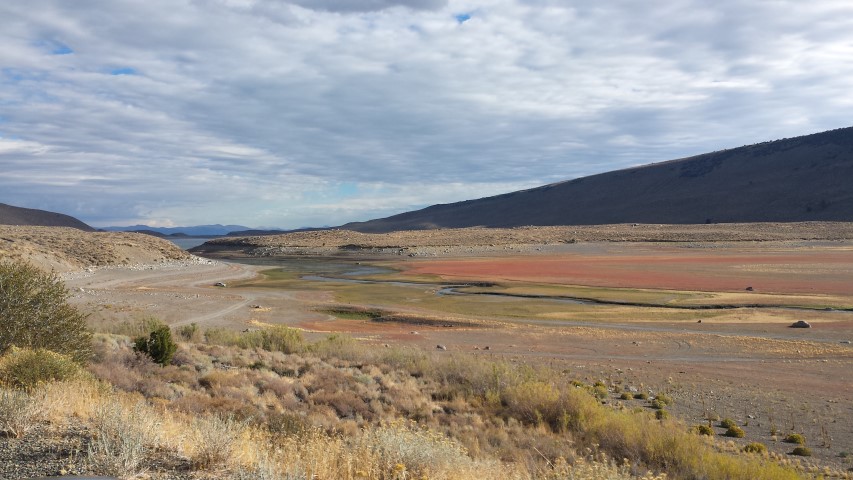
The last lake on the loop is Grant Lake, by far the largest of the four.  It serves as part of the Los Angeles Aqueduct so its level is constantly changing depending on how much water is being sucked out of it to head south.  Given the relatively good conditions at June and Silver Lakes we were not prepared for what we saw as we rounded the bend and Grant came into view.  While the photo I took (left) shows some beautiful colors, I quickly realized that I was looking at brush and other flora that used to be underwater.  Trucks and boats were parked on its shores where water used to be.    The marina, which previously sat at the center point of the shoreline is now at its most northern edge.  After spending much of our summer traveling California this was the first time we came face to face with the ravages of the drought.

Snow!

Snow in October!

We left “the Loop” and headed north to Lee Vining to see what Mono Lake looked like.  In past years when the water is low the two islands in the middle of the lake seem to be attached.  As Mono came into view it was clear that not only were the two islands seemingly connected, you could walk from one to the other without so much as getting your toes wet.  We headed back to Mammoth Lakes very depressed by what we had seen.  I’m not sure there’s enough water conservation techniques in the world that can bring Grant and Mono Lakes back up to normal levels.  The weather nerds are predicting a record-breaking El Nino this year and I sure hope they are right.  I won’t mind cancelling a few plans if it means the Sierras get dumped with snow. 

The next day, perhaps a portent of things to come, it started to rain.  The following morning we awoke to snow on the mountaintops.  We can only hope there is much more on the way.

LIVING WITH A NAG

My very first nag

My very first nag

By Suzanne Sparrow Watson

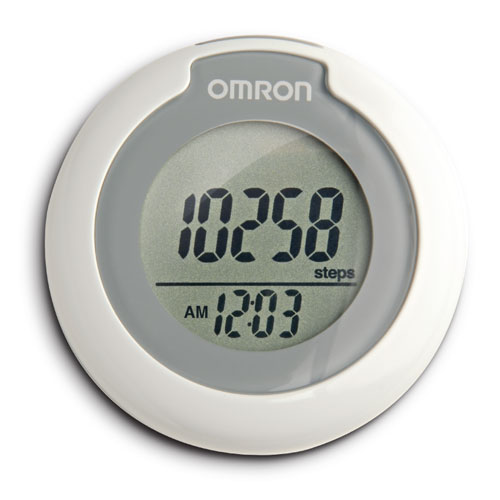
I’ve been thinking about my brother this past weekend, what with him scaling Machu Picchu and all.  We both like to walk, although putting our “walking” in the same category is like comparing Kohl’s to Nordstrom.  He goes for the big stuff (who can forget his wonderful posts from the Himalayas?) while I’m a bit more lazy down to earth.  I huff and puff riding up an escalator, so climbing mountains is definitely not my thing.  But for the past five years I have worn, in succession, an Omron pedometer, Jawbone Up band and a Fitbit Charge.  My goal with each of them is to walk 10,000 steps per day, which works out to about 4.5 miles.  Although the technology has varied among these devices, they do have one thing in common: they all nag.  There is nothing worse than checking my Fitbit mid-day only to discover that I’ve walked a measly 4500 steps.  How can I sit down to read or knit or watch a movie when “the nag” on my wrist is shouting “Get Off Your Ass!”?  Okay, maybe it isn’t really shouting at me but that’s what I hear in my head.  In general, it’s a good motivator.   I tell myself that by walking extra steps I am able to indulge in more cake, although I’m not sure that’s the intent.  The other day I got to wondering what is so magical about the 10,000 step standard.  The results of my research were surprising – and ultimately, depressing.  So, I thought, why not share it with our readers so I won’t suffer alone?

The beginning of the craze

The beginning of the      craze

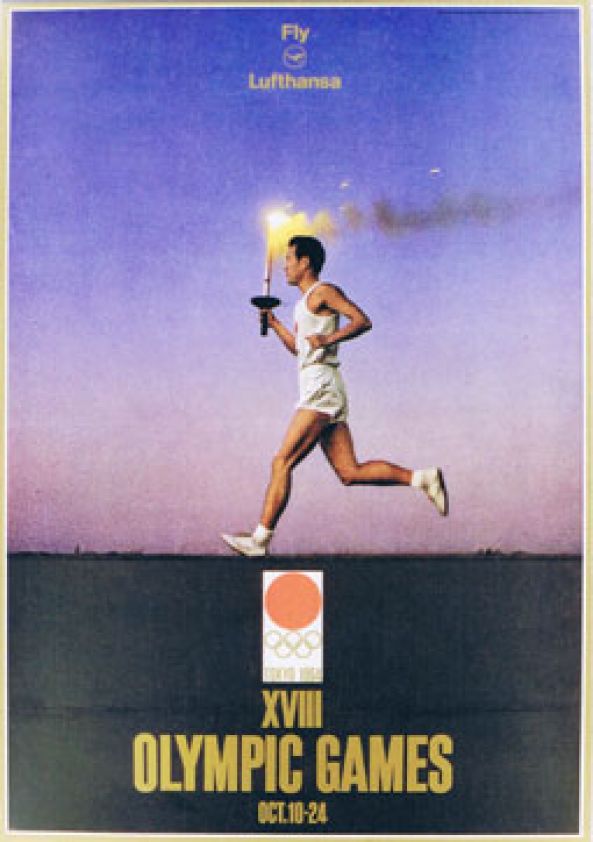
It turns out that the origin of 10,000 steps per day as a health guideline started in Japan in the 1960’s, right around the time of the 1964 Tokyo Olympics.  Apparently walking became a national “sport”, perhaps to show the world how athletic and health conscious they were.  At the time Japan was blessedly free of the U.S.-based fast food joints.  They consumed much less animal fat and fewer calories overall than most nations.  Even today, with the advent of a McDonald’s on the Ginza, the Japanese eat a healthier diet than we do;  I think it’s safe to say that Japanese television doesn’t advertise Triple Bacon Chili Cheese Deep Fried Taco Burgers.    Anyway…back to the 10,000 steps.  With the advent of the walking clubs a daily walking goal was proposed as a marketing gimmick by a company that invented a pedometer, or as it’s known there, a man-po-kei. “Man” stands for ‘10,000,’ “po” stands for ‘step,’ and “kei” stands for ‘meter’. Ten thousand, it turns out, is a very auspicious number in Japanese culture so people thought it good luck to walk that many steps.  For the Japanese, who consumed about 2600 calories per day back then, it magically resulted in improved overall health and weight loss.

Probably should be illegal in 47 states

Probably should be illegal in 47 states

The 10,000 step craze started picking up steam in the U.S. about 20 years ago when that pesky Surgeon General said that, as a nation, we were becoming too fat.  That led to the “30 minutes of exercise a day” suggestion and then it was a quick downhill slide to the 10,000 steps phenomenon.  Americans started walking more, buying pedometers, and expecting to lose weight.  But there was one snag: the average American consumes about 3800 calories every day, much of them unhealthy calories.  Which leads one quickly to the conclusion that if we’re consuming 30% more calories than the Japanese did in 1964, then we need to commensurately increase the number of steps we walk if we want the same results.  I consulted with the fitness instructor at our club, hoping she could make sense of it.  Alas, when I told her I was walking 10,000 steps a day she said, “Well, that’s good. But if you really want to lose weight, you’re going to have to walk at least 13,000.”

I can tell you right now, I’m not going to walk 13,000 steps per day.  And I’m going to continue to eat cake.  I’d rather be nagged by the device on my wrist than be like all those people on the Titanic whose last thoughts were “Damn!  I wish I hadn’t passed on dessert.”

DON’T JUDGE A BOOK BY ITS OVERALLS

By Suzanne Sparrow Watson

Don't be fooled

Don’t be fooled

As I recently mentioned, my first job after college was as the advertising and marketing director for an upscale condominium development in Fair Oaks, California.  Why they hired me, I’ll never know.  My only experience in either field consisted of placing a want ad to sell my 1965 Renault, a car that featured a push-button gear shift. It was so under-powered that Bob used to ask me whether I put it in “puree” or “blend” to climb up a hill.  I suppose that my ability to craft an ad that actually resulted in its sale did take a certain amount of talent.  And being part Irish gives me a significant leg up when it comes to shoveling out the blarney.  I suspect, however, that they hired me because I was willing to work for peanuts.  I learned a lot during my tenure at that job – newspaper ad positioning, how to write copy that lured in customers, how to drink coffee for 8 hours straight. But mostly, I learned about people.

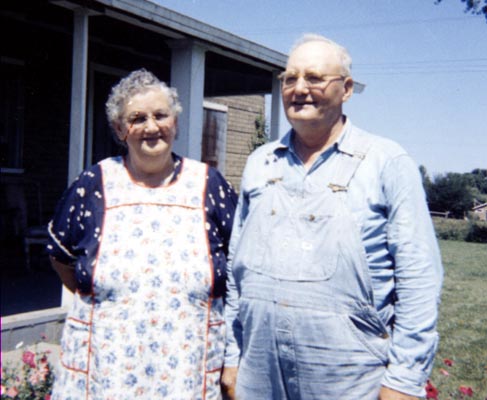
My office was upstairs from the sales office and since they had the coffee pot I wandered down to sit with them quite often.  Have I mentioned that my boss was 400 miles away?  Anyway, there were three wizened sales people who were kind enough to take me under their wing and teach me a bit about real estate and what people look for when they’re searching for a new home.  I spent a lot of time listening to them transfix customers with their “spiel”.  I thought I had developed a sense for who was a “buyer” and who was a “tire kicker” until the day an older couple (probably younger than me now!) walked in to the office. They were both wearing overalls; he had a cowlick and she was devoid of make-up with a shock of unruly gray curls.  They had literally just walked in “off the farm”. I went back up to my office while the saleswoman took them out on tour.   When she returned  I said, “Boy, that must have been a waste of time; they couldn’t possibly afford to buy in here.”  Which shows just how judgemental and stupid I was. They signed the papers that day for the biggest, most expensive unit we had, with magnificent views of the American River.

A Shining Example

A Shining Example

I have been thinking about that incident a lot lately – how I judged people by their outward appearance before I bothered to learn anything about them as individuals. It was a very good lesson to learn early in life and it helped me in my subsequent career as a Human Resources professional.  Not that I don’t judge people any more.  I have plenty to say about the Kardashians without ever having met any of them and I’m pretty sure that my impressions are spot on.  But it seems to me that we as a society are increasingly judging people using broad stereotypes. Black, white, Hispanic, cops, youth, Christians, gays, Democrats, Republicans…the list goes on and on.  When did that happen?  Or, more importantly, why? I’m not sure there is any one answer and certainly it would take someone above my pay grade (which is $0) to figure it out.  If I had to guess I’d say it has something to do with the advent of 24 hour cable news and the internet, both of which derive income by staking out corners in the far reaches of an ideology and then catering to people who reside there.  My experience tells me that the vast majority of Americans judge people as people, regardless of their race, creed, religion, sexual preference or whether they drink Chardonnay or Budweiser.  But these days it seems my Facebook feed is bombarded with posts, or more accurately re-posts, of some half-truth that generalizes and paints an ugly picture of some group.  As a rule of thumb, any group that has “Occupy” or “Tea Party” in its name is not going to provide a completely truthful analysis.  I’m on Facebook less and less because of this problem and will be un-friending people who continue to “share” those posts.  I don’t even want to think about how much more vitriolic social media will become as we inch toward the 2016 election.  And you’d best believe that the people who are running the campaigns will count on the masses to spread the half-truths to further their cause.

So I say we just STOP!  Let’s not be manipulated by people who have an agenda.  Let’s refrain from posting or forwarding information that is partisan or with an obvious bias.  Let’s not lump everyone into an amorphous group – let’s think about people as the individuals that they are.  Except when it comes to contractors.  Given my recent experience with our bathroom remodel, they deserve every bad thing ever said about them.


THE “OTHER” WINE COUNTRY

By Suzanne Sparrow Watson

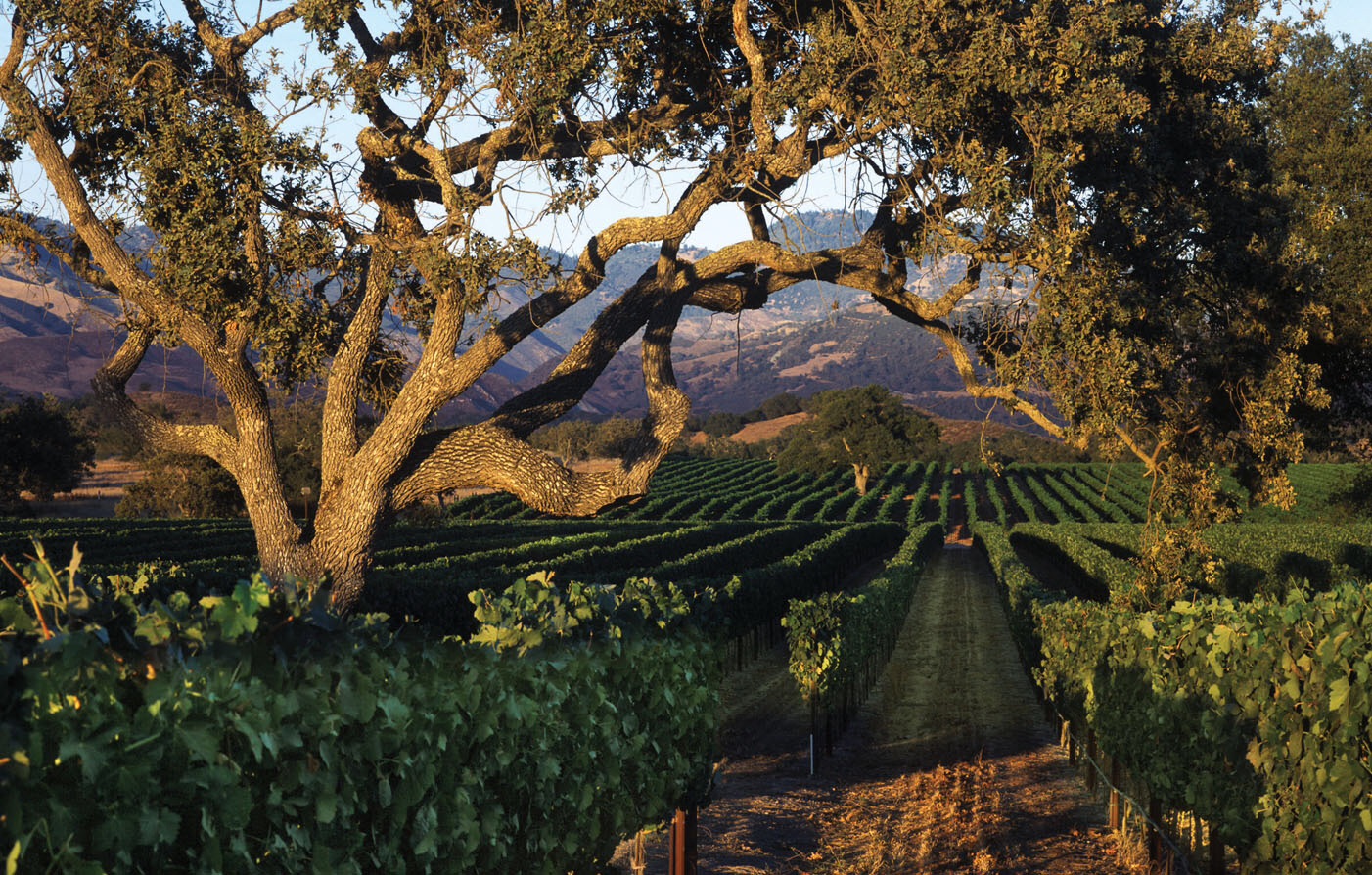
The Beautiful Central Coast

The Beautiful Central Coast

Each year we spend some part of the summer in the Central Coast region of California.  It’s beautiful beaches, oak-studded hills and temperate climes make it the perfect place to escape the heat of Scottsdale in July and August.   Well, let’s face it, anyplace that has temperatures less than 105 is the perfect place.  But literally, the Central Coast has been designated as having the most consistent weather in. the U.S.  In the last dozen years it’s also become known for something else – wine!   The San Luis Obispo and Santa Barbara county wine-makers are giving their northern brethren a run for their money.    They have a long way to go, but having grown up in Northern California, I can remember when Sonoma and Napa were best known for dairy farmers and ranchers.  The Gallos were the biggest wine makers back in the day, generating their huge bottles of Italian reds that were cheap even then.  Once the Mondavis and Beringers began cultivating serious wine grapes, well, the rest is history.

On the Central Coast our ventures out to the wine trail usually take us to the vineyards of Santa Barbara County for reasons that will become evident later.  The first recorded wine-maker in the area was none other than Junipero Serra, who planted the first vines back in 1872.  I must say, between founding missions and exploring the El Camino Real, Father Serra was a pretty busy guy.  In any event, over the following 100 years the area gained  sixteen more vintners and grew to over 260 acres of grapes.

Sadly, during the Depression the Prohibition buzzkills burned many of these historic vineyard sites and mostly put an end to winemaking in the Central Coast.  Fortunately,there are always those that find their way around any ridiculous law so the passion for wine making was carried on by a group of scofflaws.  From that small seed, or vine as the case may be, grew the abundant grape-growing region that exists today.  In large part, the recent popularity of Santa Barbara County wineries can be attributed to the wonderful little movie, “Sideways” which was filmed in and around several of the local venues.  The popularity of the movie turned out to be a boon for tourism and local wine, especially the Pinot noir that the region is famous for.  (For those of you who have seen the movie I can attest that it is possible to get a bottle of Merlot here too!).

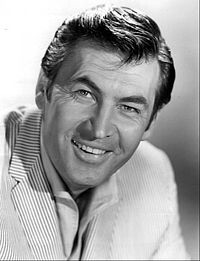
Fess, in his Davy Crockett days

Fess, in his Davy Crockett days

So why do we frequent the Santa Barbara County wineries? Because our brother, Jack Sparrow, works for the Fess Parker Winery.  Lucky?  You bet!  But we have a long history in our family of having fun retirement jobs.  When our dad quit his day job he worked at Sonoma National and then his local golf course as a starter until he was in his early 80’s.  Our mom, who was rivaled only by the Queen of England in her love for jewelry, retired from the local school district and worked at a jewelry store until she was 90.  Brother Bob helps people, which is his passion, in both volunteer and part-time jobs, and as a life-long fiber enthusiast, I have been lucky enough to work part-time in a knitting shop for 13 years.  But it is brother Jack who really lucked out.  He spent most of his career in the restaurant business, even owning his own place in Tahoe for a few years.  So he knows his way around food and wine (as opposed to the rest of the family that just consumes lots of both).

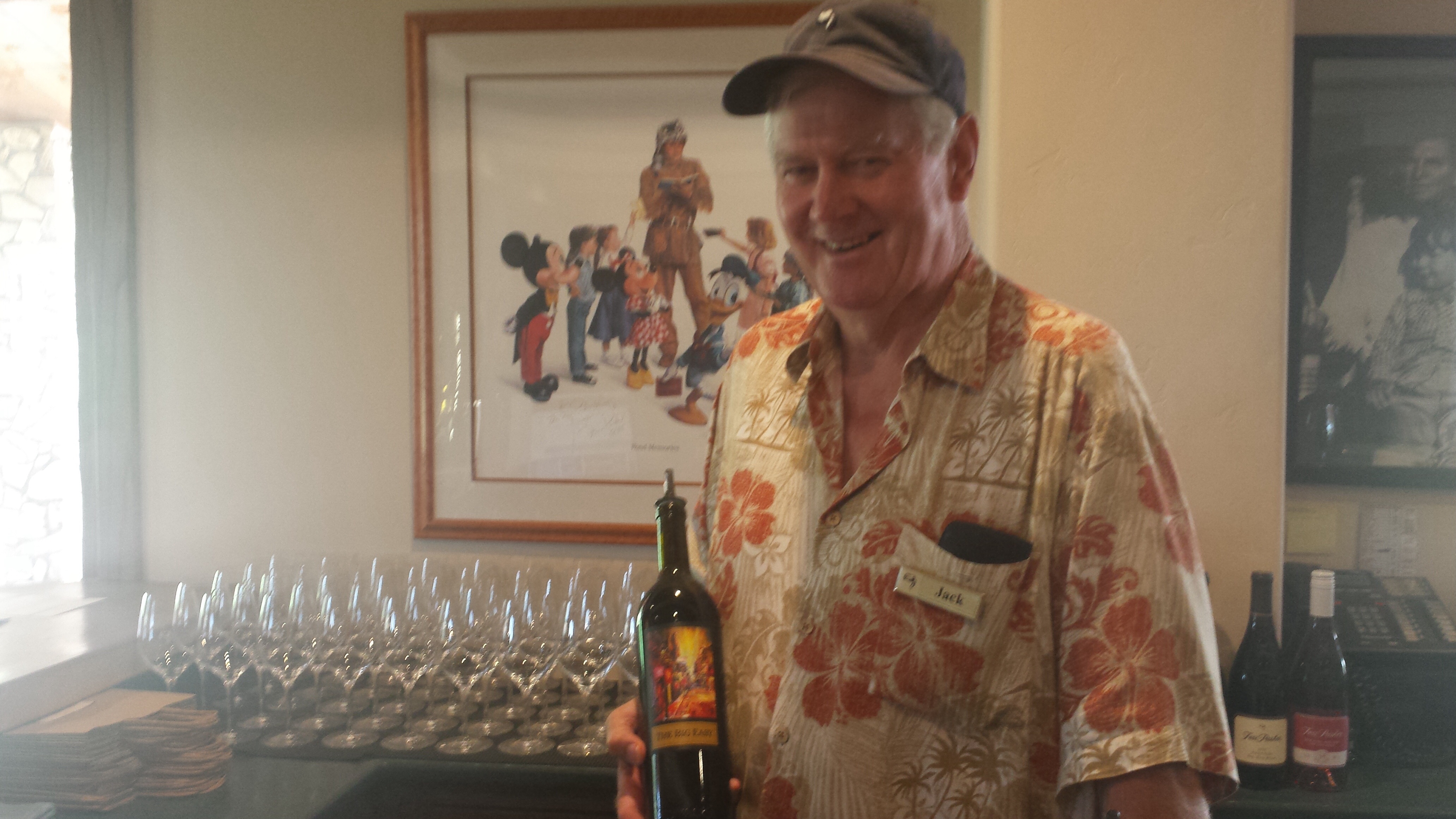
Jack, displaying his wares

Jack, displaying his wares

Ten years ago when Jack and his wife Sharon moved to the Central Coast Jack went in search of a fun retirement job.  He was hired at Fess Parker Winery and soon met “the man” himself.  For those of a certain age, we remember him best for his portrayal of Davey Crockett.   Jack spent many hours with Fess, hearing about his days in Hollywood and with Disney.  But it was Fess’ love of wine-making that captured Jack’s attention.  He absorbed all that he could until Fess died in 2010.  Now, every Monday, Wednesday and Friday you can find Jack behind the bar in the tasting room, regaling customers with stories about Fess, the winery and the wines.  Jack’s great oratory skills (we have another name for that in the family) are evident in the rapt attention that his audience gives him. Seriously, although I’m the one working in a knit shop, it is Jack that spins a good yarn.  My husband says that the most fun he has is sitting quietly in a corner of the tasting room, watching Jack work his magic.  It is no coincidence that he has been the top seller of wine club memberships for several years running.

The Fess Parker Winery

The Fess Parker Winery

By the time you read this we will be home inspecting our remodeling project and, thus, drinking lots of wine.  If your travels take you to California I highly recommend a stop in the Central Coast.   Just one warning:  if you go to the Fess Parker winery when Jack is working, reconcile yourself to walking out of there a wine club member!


OLDER…AND WISER?

By Suzanne Sparrow Watson

GratitudeThis month I celebrated a milestone birthday. I am not unhappy about celebrating another birthday. In fact, this past year has given me reason to be especially grateful that I’m adding a candle to my birthday cake. And not just because it was the Costco All-American chocolate cake or because I got to spend it with my brothers and their wives.  In the past ten months my best friend passed away suddenly, an old friend succumbed to cancer, three acquaintances died, a close friend’s grandson was killed in an auto accident and another’s husband was diagnosed with ALS. Two more friends’ husbands were told they have Alzheimer’s. I don’t even want to discuss the people who have had the ubiquitous Senior Citizen joint replacements.

At one point I thought “Enough!” I don’t need any more signals that I should appreciate each day and every person in my life. I get it. But all of these events got me to thinking about what else – if anything – I’ve learned along life’s highway. I reflected on those philosophies or words of wisdom that have stuck with me. Some I learned as a young woman, some with gray in my hair. There are lessons I learned that are serious and some…well, not so much. Here’s what I came up with – “Life Lessons” if you will – in no particular order:

Do-Gooders

Do-Gooders

People who repeatedly tell you how wonderful they are – aren’t. My first job out of college I worked as the head of marketing and advertising for an upscale condominium developer. One of my first clients told me incessantly about her Christian faith and how devout she was. She then proceeded to deal with everyone in an underhanded manner six ways to Sunday (when, presumably, she was on her way to church). It was a good lesson to learn early in life – beware of self-promoters.

Duct Tape and WD-40 are the answers to all home repairs. I read this at least 30 years ago and thought it was a joke. Turns out it was pretty good advice. If it sticks, grinds or squeaks, spray it with WD-40. If it’s cracked, split or fractured, slap some duct tape on it and you’re good to go.

You choose your destiny. Many years ago I read Wayne Dyer’s Book, “The Sky’s The Limit” wherein he states that we have a choice in how we approach our lives, and that choosing to be happy is, in the long run, far easier than wallowing in misery. He’s right.

Perspective is key. I love Robert Fulghum’s philosophy on this:  “Life is lumpy. And a lump in the oatmeal, a lump in the throat, and a lump in a breast are not the same lump. One should learn the difference.” Wise words.

I need more light and magnification each year

I need more light and magnification each year

A woman’s best friends after age 50 are tweezers and a high-powered magnification mirror. ‘Nuff said.

Enjoy the process. Twenty years ago I was putting together a big conference at work, hosting more than 1,000 people.  It was months in the making and I was stressed out to say the least.  The event planner finally looked me in the eye and said, “You’d better enjoy the process because the actual event is only 8 hours.”  It was good advice that has ended up having broad application for life in general.  Since then I’ve tried to enjoy the journey.  Except during a root canal.

When given the choice between being right and being kind, choose to be kind. This was another great lesson from Wayne Dyer that I heard just last year.  I wish I’d heard it 30 years ago.

Let it Go. Long before Disney turned this phrase into an annoying song, it was a great philosophy for dealing with anger or frustration. It has taken me too long to learn this lesson, but I now think twice before getting mad and saying something I might regret. And I’ve learned that after writing a snarky email if I wait a day to hit “send” it results in 99% of them getting trashed. My Irish ancestors would be proud of my temper control!

That’s it. I’m sure I’ve learned more than this, but my memory isn’t what it used to be. I’d love to hear what your “Life Lessons” are unless it’s “Buy low, sell high”.  I’m apparently incapable of learning that.

THE TRIFECTA OF COOKING DISASTERS

By Suzanne Sparrow Watson

Senior Citizen porn

Senior Citizen porn


I am not a good cook.  Never have been.  But I yearn to be great.  I watch the Food Network  with great enthusiasm.  I imagine myself twirling around in the kitchen, dazzling my friends with my expertise, amazing them with my magnificent meals.  If watching TV magically translated into an actual skill, I would be stir-frying, sauteing and braising everything to a turn.  I’ve observed so many baking episodes that I should be rolling out fondant and spinning sugar roses on a daily basis.  But alas, my intellectual understanding of food and my ability to produce edible meals somehow are at odds.  In all fairness, I’ve not killed anyone yet but as you will read, I’ve come darn close.


My Gournet Main Course

My Gourmet Main Course

I should have known that cooking was not going to be my strong suit back in 1972, when I was living in my first apartment.  At the time I was dating a lawyer who took me to very nice restaurants.  Back in those days (I think it was the Paleozoic era), men always picked up the bill.  So occasionally, the woman was expected to host a home-cooked meal.  It was a great system.  After a couple of months I just couldn’t mooch one more meal from this man, so I worked up the courage to host him for dinner.  I decided on a Mexican theme.  I decorated with colorful flowers and planned out the menu; I think I even threw a red sash around my waist thinking it would add a certain je ne sais quoi to the evening.  As if a red sash was going to make up for canned tamales. Yep – the prep for my main course consisted of me reaching into the tool drawer, pulling out an old screw-type can opener, and dumping the tamales in a pan.  I think I may have served canned Mexican rice too.  Shortly after we finished eating this tour-de-force of can opening, my date asked if I had an Alka-Seltzer.  I did not.  So he suggested (rather kindly as I think back on it) that we go out for an after dinner drink at the local pub.  Only he didn’t have a drink – he ordered club soda.  Not surprisingly, I never saw him again.  And I was so naive that it was years later before it dawned on me I had caused him to suffer from heart burn, indigestion and God only knows what other type of gastrointestinal disorder.

Fast-forward 43 years to last month when I experienced the Triple Crown of cooking disasters. First, we were invited to a pot luck where I volunteered to bring a chicken dish.  I consulted my Ina Garten cookbook, How Easy Is That?, because I was definitely looking for easy.  I selected the Lemon Chicken that required boneless chicken breasts with the skin left on.  Not wanting to cut open an artery while de-boning a chicken breast, I purchased de-boned chicken breasts from our local gourmet market for approximately the price of a Porsche.  The recipe says to simply put the chicken in the lemon sauce and bake it, whereupon the skin is supposed to “crisp up”.  As the time approached for us to leave, I peeked in the oven.  No crisping.  I panicked and turned up the heat.  Still nothing.  Finally, we had to leave for the party so I pulled the dish out of the oven.   The end result looked like islands of fat floating in lemons.  I’ve seen better looking skin in a nursing home.  I secretly told everyone that someone else brought that horrid chicken dish.

Mine looked NOTHING like this

Mine looked NOTHING like this

Next I decided to bake my husband’s favorite dessert for his birthday – Pineapple Upside Down cake.  He is on a restricted-fat diet so I found a recipe that used applesauce and club soda as substitutes for anything that actually tastes good.  When the baking time was up I took it out of the oven only to discover that it resembled a yellow Frisbee.  Actually, that comparison might be insulting to the Frisbee.  One of my good friends, who is a fabulous cook, told me that next time I should make a full-fat version and just serve a smaller piece.  Hmmmm…a smaller piece of cake.  Not something usually in my wheelhouse.

The third disaster occurred last weekend when I tried to make up for the birthday cake disaster by fixing an angel food cake.  In fact, I went a step further and found Ms. Garten’s Lemon Angel Food cake recipe.  Perfect!  My husband loves lemons and the cake is naturally fat-free.  The recipe couldn’t have been further from my canned tamales in terms of effort.  The flour, sugar and salt had to be sifted FIVE times.  Finally – it was in the oven and I hovered over it like a mongoose watching a snake.  It rose beautifully.  When I took it out of the oven it was high and crispy (if only my chicken skin had looked that good).  I inverted it on the counter and went into my office to relax while it cooled.  Ten minutes later my husband walked in and said “Honey, I think your cake fell”.  I assured him that an angel food cake is supposed to be upside down while it cools.  To which he replied, “No, it actually has fallen.”  I raced into the kitchen.  Sure enough, my angel food cake was a steaming heap of molten mess, having made a huge splat when it hit the counter.  Pure unadulterated pride kept me from taking a picture of it.  Instead, I did what any reasonable person would do – I threw it in the garbage and poured myself a glass of wine.

I’m going to start watching The Wine Network.  All that’s necessary for success is to select a bottle of wine, open and pour.  Now, how easy is that?


A Cup of Coffee and a Newspaper

by Bob Sparrow

selfie

The news is mostly about ‘self’!

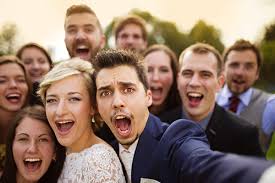
I read in the newspaper last week . . . yes, I still read a newspaper; I realize I’m in the minority, as both newspaper sales and newspaper advertising revenue are falling like a prom dress. If you ask the younger generation where they get their news they will invariably tell you ‘on line’, but all I see is faces buried in their phones while ‘tweeting’, ‘liking’, ‘Instagraming’ or posing for ‘selfies’. Their ‘news’, I suspect, comes more from ‘You Tube’ than the ‘Boob Tube’. Which means, they may not really care that much about the news – which I understand as it is mostly depressing.

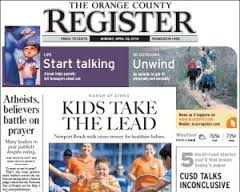
Call me sentimental, but I like knowing that the Orange County Register staff worked late into the night to gather the registernews, print it and deliver it to my driveway before I get up the next morning.   I do understand that newspaper news is a day old, but do I really need the up-to-the-minute scoop on what the Kardashians are doing or what political figure bashed what political figure today? It’s not like someone is going to ask me to weigh in on our Middle East policy. Do we even have a Middle East policy? Besides, can you line the bottom of your birdcage with your computer? Can you roll up your iPad and admonish your dog? Can you get a fire going by lighting your cell phone? I think not!

I stare into my computer at work, I’m glued to my laptop when I’m writing or perusing social media and I read books on my iPad; my eyes are thankful for the respite from the bright glare of electronic devices and welcome the act of sitting down with a cup of coffee, relaxing and reading the morning news, smug in the knowledge that my newspaper isn’t going to ‘crash’, ‘freeze’ or ‘lose its connection’.

latte

This is NOT a health drink!

A cup of coffee! That’s what I started to write about before I so rudely interrupted myself with this newspaper rant. Coffee’s history is quite the opposite of newspaper history; sales are increasing as well as prices, especially for that ‘Venti Half-Caf Caramel White Chocolate Mocha Cookie Frappuccino Latte with a shot of Espresso. Again, I know I’m in the minority here, but I still like a plain cup of coffee and as I started to say, I read in the newspaper last week that coffee, which has had a mercurial reputation, is now once again, good for you!  The article I was reading was from New York Times writer, Aaron E. Carroll, and he, like many of us, grew up in a time when our parents drank coffee, but told us not to because it would stunt our growth. For the most part we believed them and didn’t drink coffee until we thought we were tall enough. We’d see midgets, jockeys and the Seven Dwarfs and think, ‘coffee drinkers’.

Carroll sites numerous studies that show the benefits to coffee drinkers; lower rate of virtually all cardiovascular disease, lower risk of liver cancer and lower risk of prostate and breast cancer. For those who already have liver disease, coffee is associated with decreased progression to cirrhosis. Coffee intake was associated with lower risk of Parkinson’s disease, lower cognitive decline and a potential protective effect against Alzheimer’s disease. Coffee (all these studies refer to ‘black’ coffee, no sugar or cream, but can be caffeinated or decaffeinated) was associated with a significantly reduced risk of developing type 2 diabetes.

Pretty impressive I think! But we don’t drink coffee as a ‘health drink’, although a regular brewed coffee has 5 or fewermug calories and no fat or carbohydrates; we drink it because it taste good and perhaps because we’re hooked on caffeine and need that ‘legal stimulant’ to kick-start our day.

OK, give your eyes a rest, you’ve been staring at your computer long enough, turn it off (Oops, first ‘share’ this blog with a coffee lover you know, it will make them feel better about this morning’s cup of coffee), grab a newspaper and another cup of coffee and relax, that is if coffee doesn’t give you the jitters or make you run to the bathroom. Hey, nothing is perfect!