LET’S TAKE THE HIGH ROAD

By Suzanne Sparrow Watson

Every few years, the world unites in a grand celebration of football. Or as we in the U.S. like to say, soccer. Half of Americans’ experience with soccer begins and ends with 7-year-olds on a field, clueless about the game but excited about the sliced oranges at the break. The other half thinks FIFA is a type of allergy medication. But this year, something magical is happening: the Tartan Army and other international fan groups are pouring into the U.S. for the World Cup, ready to turn American cities into temporary outposts of global football culture. And America had absolutely no idea what was coming.
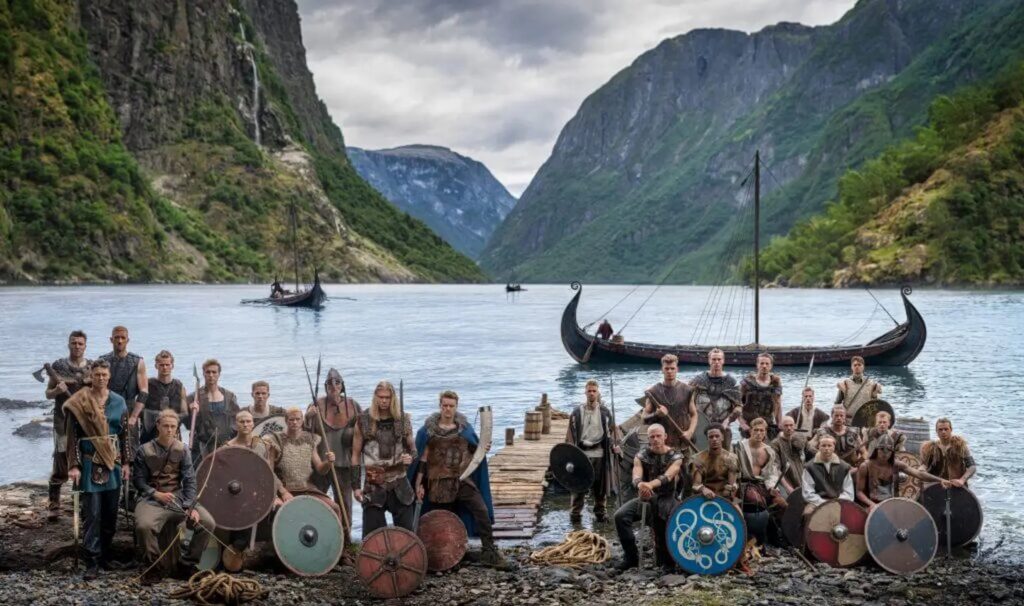
The Brazilians arrived radiating sunshine, samba, and the kind of confidence that comes from supporting a team that actually wins things. They immediately attempted to teach Americans how to dance, only to discover that many locals move like malfunctioning shopping carts. The English fans, who are thrilled to discover cheeseburgers and Ranch Dressing, enjoyed explaining—loudly, repeatedly, and to anyone within a five‑mile radius—that this will be their year. (It will not be their year.) The Norwegians came loaded for bear, having posed for their teamphoto as vanquishing ancient Norsemen. They have done “the row” (as if in the boat) at the stadium and more ingeniously, sitting on the “up” escalator at the Boston airport. The Germans showed up with precision, efficiency, and laminated itineraries. They are the only fan group that reads the stadium rules in advance. They are also the only ones who will arrive at the match three hours early “just to be safe.” I have some German lineage and I can attest that this is true.
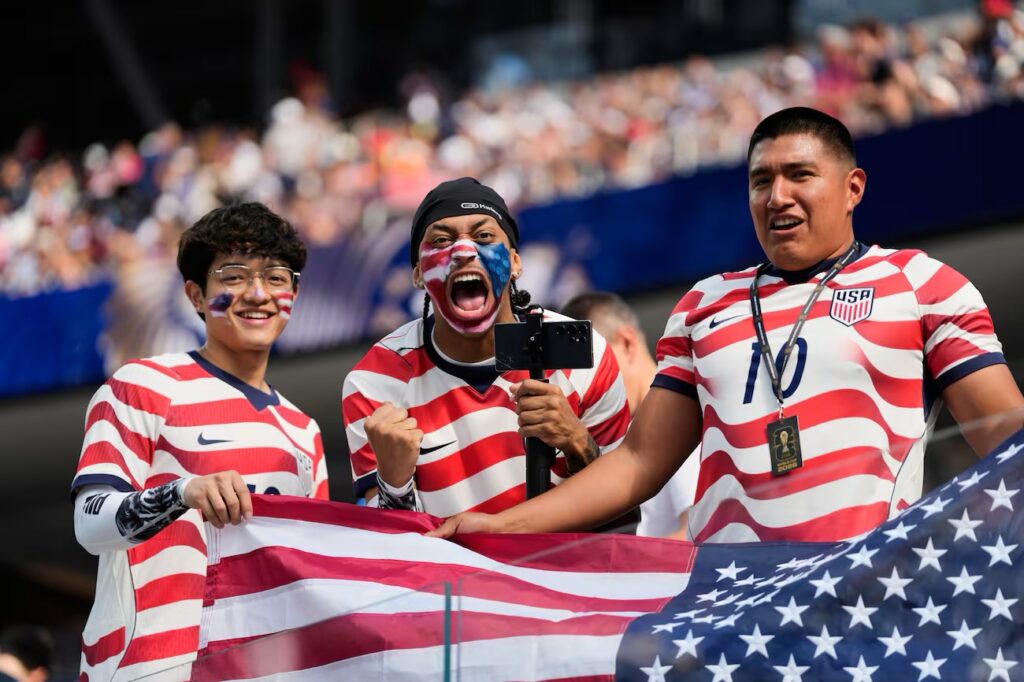
The Argentinians arrived with Messi flags, Messi shirts, Messi tattoos, and at least one person who has named their firstborn “Messi.” They are prepared for glory. They are also prepared to argue passionately with anyone who suggests another player might be better. And meanwhile, we Americans are trying our best. We’ve decorated stadiums with red, white, and blue. We’ve Googled “how to chant like Europeans.” We’ve even practiced saying “nil” instead of “zero,” though it still sounds like we’re ordering a latte. But we learn quickly. After the win against Australia the U.S. fans sang “Country Roads” in unison, and people who were there said it was the most unified they had felt since 9/11. I wish John Denver was alive to hear how healing his song has become.

But let’s face it, it’s the Scots who have stolen the show. The Tartan Army has been Scotland’s most enthusiastic export after whisky and passive-aggressive weather. They arrived in full tartan regalia, kilts swishing proudly in the breeze, armed with bagpipes, optimism, and a deep, ancestral understanding that their team may not win—but by heaven, they will out‑party everyone. As they say, “No Scotland, no party!” They discovered that American beer is often served cold. Despite this, they still drank Boston dry. Many bar owners said they’d had to make emergency orders, having significantly underestimated how much the average Scot can drink. They also learned that some statues in the U.S. are quite tall, making it hard to place a traffic cone upon the top of it (long story – look it up). But just to show how charming the Tartan Army is, in Providence, R.I. the city maintenance workers gave a lift to a Scotsman in their cherry picker so he could complete the mission.
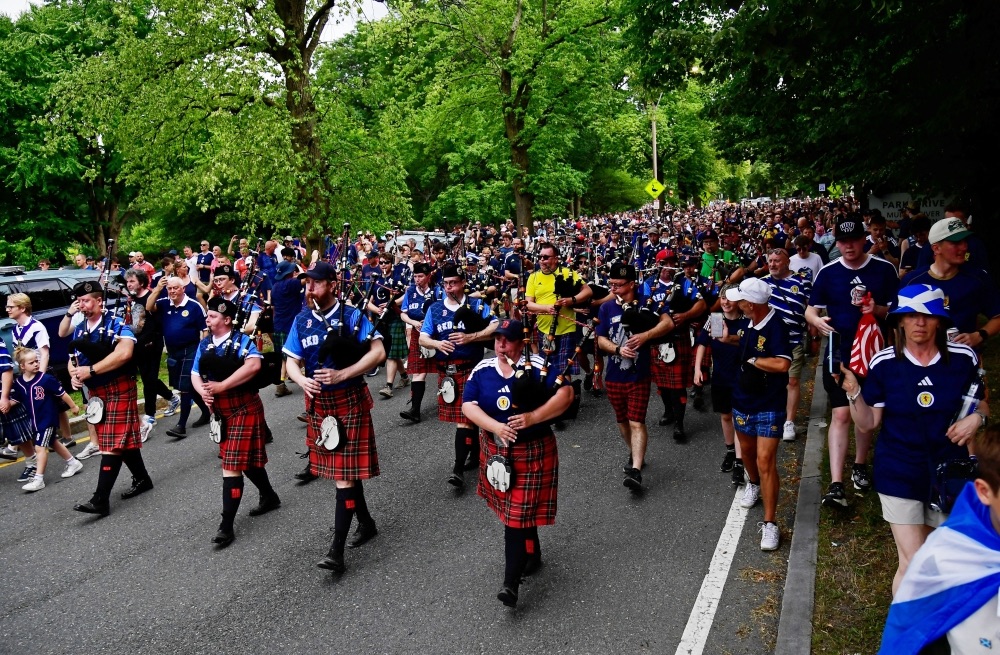
We Americans quickly learned that the Tartan Army is loud, joyful, and unstoppable. They sing in the streets. They sing in the stadiums. They sing in hotel elevators, which is confusing for guests who thought they were stepping into a quiet ride to the lobby and instead find themselves in a mobile Highland ceilidh. And yet—Americans fell in love with them. Because the Tartan Army, like all great football fans, brings something the U.S. can’t resist: pure, unfiltered, wholehearted enthusiasm.

They also brought manners and grace. A woman bartender in a Boston restaurant was the only person on duty when hundreds of the Tartan Army entered. She worked as quickly as possible to get them all drinks. When her shift ended, she told a local news reporter that to a person, they were polite, respectful and fun. The Scots had a party in a Boston park with over 2,000 people. Only one maintenance worker was scheduled to work the next day (I’m beginning to think Boston didn’t realize that FIFA was in town). Anyway, he said the park was so clean when he came to work, he just had to pick up the bags of trash the Scots had piled up for him. Finally, the Tartan Army was so overwhelmed by the friendliness and warmth of the Americans that they donated $30,000 to local charities as a thank you for welcoming them. And then they collected more money, giving $10,000 to a children’s cancer charity, $6,500 to a program to teach kids how to play the bagpipes, and $10,000 to a program that teaches underprivileged kids to play soccer. The Tartan Army reminded everyone that sport isn’t just about winning. It’s about belonging. It’s about joy. It’s about wearing a kilt in 105‑degree heat because tradition matters more than comfort. They’ll go home sunburned, dehydrated, and hoarse from singing—but proud. Because they didn’t just come to watch football. They came to conquer America, and they did. With kilts and kindness.

And we learned something about ourselves in hosting all of the international fans. In 11 host cities across the U.S., foreign tourists and ordinary Americans have created diplomacy that puts professionals to shame. And we got the wake-up call we needed: we are not our politicians or the media. We are good-hearted people who have more in common than we have differences. We love to gather together, laugh and sing. Now we just need to figure out a national chant.
PEACE IN THE MOUTAINS

By Suzanne Sparrow Watson

image

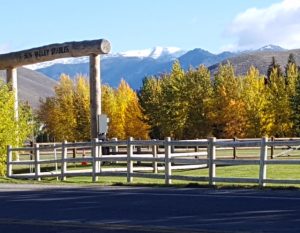
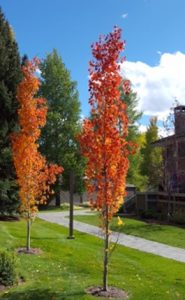
Turning leaves in Sun Valley

Fall is my favorite season.  After all, it’s the time of year when you can get a Pumpkin Spiced Latte at Starbucks and Costco offers their manhole-sized pumpkin pies.  This year Dairy Queen in entering the fray by offering a dessert consisting of vanilla ice cream, bits of pumpkin pie, topped with nutmeg and whipped cream.  No wonder I gain weight every October.  I come by my love of fall naturally – 20 years ago I had my colors analyzed and it was determined I’m a “Autumn”, meaning I look best in the colors found this season.  But mostly I love this time of year because this is when we make our annual trek up to Sun Valley, Idaho where the air is fresh and the leaves are turning.  And, not by coincidence, the kids are back in school so it is also quiet.


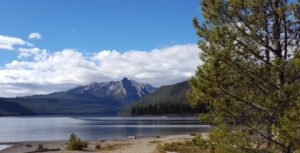
Redfish Lake

Redfish Lake

There is something very peaceful about being in the mountains.  I’ve read some recent articles about how people who reside in the mountains live longer.  The research indicates that it’s because of cleaner air, more outdoor activity, and increased aerobic function due to the altitude.  I don’t know about all that – I suppose if the researchers say it then it must be true.  But this week as we drove up to Redfish Lake, near Stanley, Idaho, I thought back to a study that I read years ago.  I have searched the internet to find it again but it’s probably too old even for Google’s capabilities.  The essence of the thesis was this: people who reside in the mountains live longer because they see themselves in perspective.  It went on to theorize that it is hard to take our human problems and even our very existence too seriously when staring at the magnificence of high-peaked mountains.  In other words, when we view ourselves in relation to nature we gain a greater realization that we are only a small cog in a much larger scheme.

Snow in September

Snow in September

That feeling has certainly been forefront in our trip this year.  We have marveled at the vibrant colors of leaves turning and the first dusting of snow on top of Mount Baldy.  When we are outdoors experiencing this magical place, it seems as if all is right with the world.  When we drove home from Redfish Lake the other day, with no satellite radio and no cell service, we had only the glorious scenery, the Salmon River and some antelope to occupy our thoughts.  We were both filled with an overwhelming feeling of peace.  But then, as we returned to “civilization” reality crashed down on us.  A basket full of deplorable candidates for President, racial strife across the country and more terrorist attacks.  I certainly don’t have the first clue as to what the cure is for our collective problems.  All I do know is that  John Denver had it right when he wrote the following lyrics:

“Now he walks in quiet solitude the forest and the streams
Seeking grace in every step he takes
His sight has turned inside himself to try and understand
The serenity of a clear blue mountain lake”

We’ll be leaving Sun Valley this week and I will miss this beautiful place more than ever.  Am I escaping reality here?  Probably.  I am just sorry that the whole world cannot feel the peacefulness of the mountains.  God knows we need it.

TO THE LAND OF OZ: Part One – The Santa Fe Trail

imageHopefully  by now you have read my brother’s fabulous account of his trip to the dark continent.  While you were reading about his encounters with wild animals, smiling people and beautiful sites, my husband and I, along with our faithful dog Dash, were about to embark on a trip to the dark continent of …..Kansas.

Earlier this year our daughter and family moved to Leawood, Kansas, which we thought was somewhere close to Antarctica.  We envisioned flat terrain and not a Starbucks in sight.  But, longing to see our grandsons, we decided to pack the dog in the car and drive the 1200 miles to their new home.  We are always up for a driving adventure and since we had not seen this part of the country we decided to make the most of all the sights along the way.

The first day we got as far as Santa Fe, New Mexico.  We have only been there once before and found it to be a charming city.  On that trip we walked the Square, bought art on Canyon Drive and ate at Geronimo’s and The Compound.  At night we returned to a lovely resort.  We found out the hard way that none of those things are possible when you travel with a dog.  This time we stayed at a LaQuinta Inn near the freeway.  Not even a new LQI.  This one closely resembled the Bates Motel.  And we soon discovered that finding a place to eat dinner with a dog in tow is tantamount to finding the Holy Grail. We consulted our “Traveling with Fido” resources but they offered imagesuch gourmet delights as McDonalds and Sonic Burger.  My husband batted his baby blue eyes at the hostess at the Olive Garden and she let us take the dog out to the patio to eat with us.  In 30 MPH winds.  And, sadly, we were thrilled.

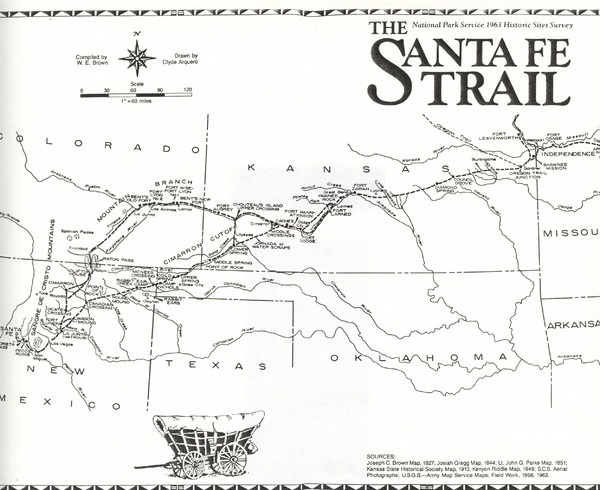
The next morning we set out for the wide open spaces, with a goal to reach Hays, Kansas by nightfall.  We were excited to get off the interstate at Trinidad, CO. and begin to see the “real” countryside via “blue highways”. We talked about seeing the original Santa Fe Trail – Dodge City! – and reliving some of the scenes we saw on all those Westerns on TV in the 50’s.  We lasted 10 miles.

After numerous potholes, uneven pavement and several near-miss side-swipes, we decided that maybe our kidneys (and nerves) were too old for this trip.  I’m not certain, but I would almost swear that the dog whispered into my husband’s ear “Please get us back to an interstate”.  So after 75 miles heading east on the Santa Fe Trail, we made a sharp left turn and high-tailed it up towards Interstate 70.

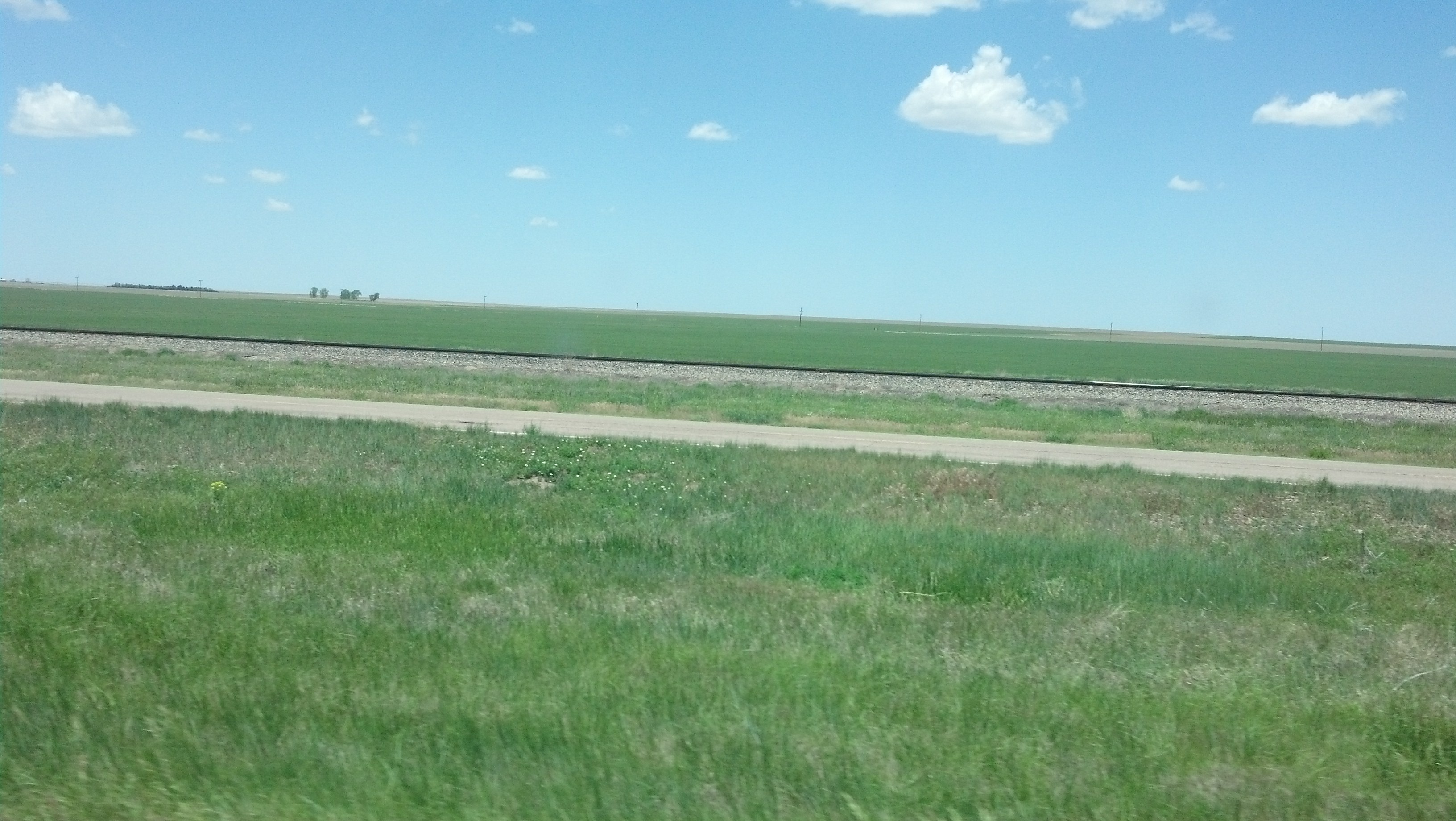
We followed State Route 71 in Colorado through farmlands and small towns.  When one thinks of Colorado one normally thinks of mountain peaks and snow.  John Denver made a lot of money singing about that image“Rocky Mountain High”.  However, eastern Colorado looks a lot like the midwest.  Wheat and grain fields dot the country side.  You can see from the picture (right) that there is not a hill in sight.  I think Sara Palin can see her house from here.  We drove through lots of small towns along the way and we both felt as if we had been transported back to our childhoods, where Main Street was filled with small shops, a gas station and one market.  Most of the towns had one store where its citizens buy everything from a bow tie to shoes, from cradle to grave.  I’m quite sure the locals haven’t ever seen a J. Crew or Banana Republic and they appear to be getting along just fine.

Finally, blessedly, we reached Interstate 70 at Limon, CO.  Another McDonald’s and a gas station were the highlights but it looked like an oasis to us.   We continued east at 80 MPH and entered Kansas.

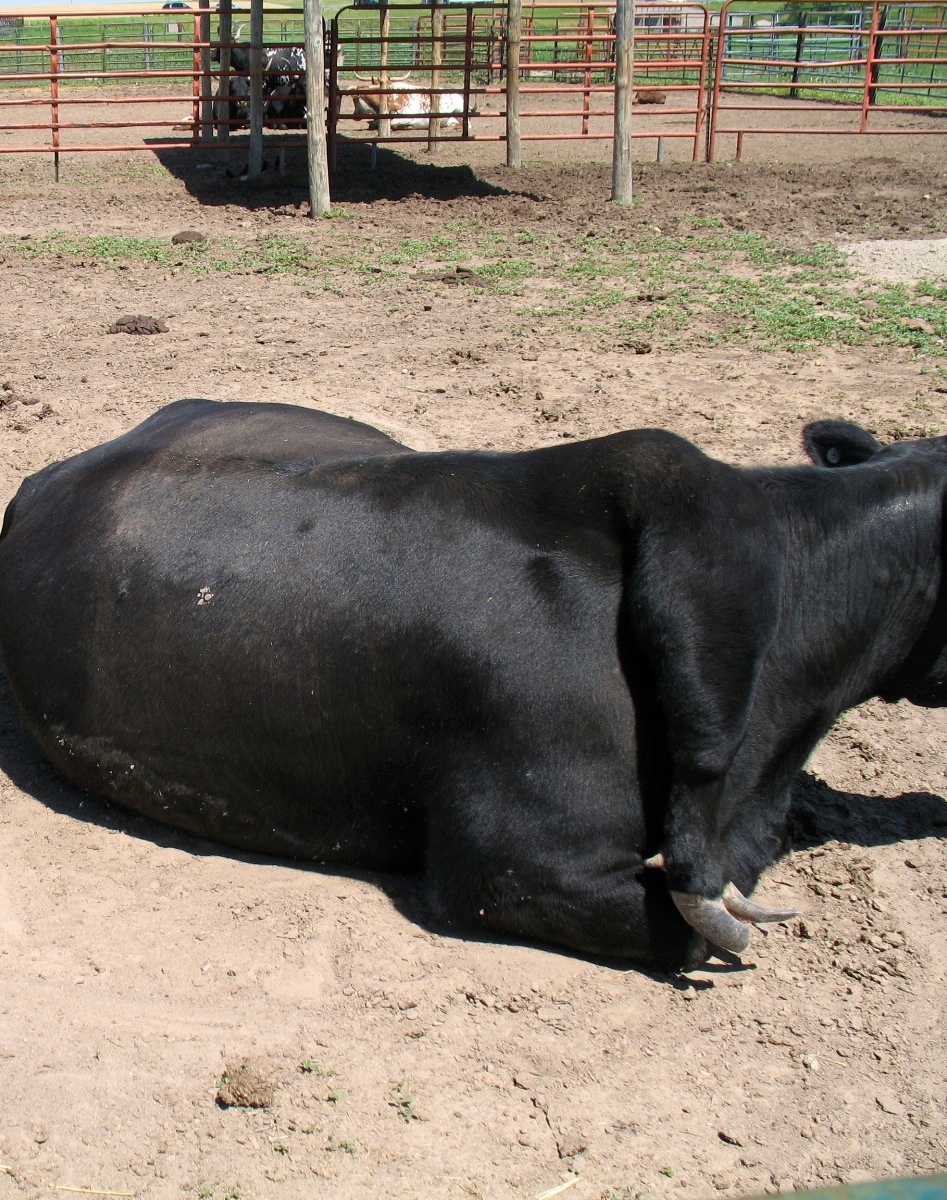
Our first clue that Kansas might be a bit boring was when we saw signs offering free coffee at the border station.  I suspect, now that I’ve driven through the state, that the wise officials in Kansas knew that without caffeine the countryside would lull drivers to sleep at the most inconvenient times – like when driving in the fast lane.  The only exciting “attraction” along the Interstate were the billboards every 10 miles touting the museum in Colby that housed rattlesnakes, coyotes and a five-legged cow.  Rattlesnakes and coyotes are a dime a dozen where we come from, but a five-legged cow?  Now THAT’S an attraction.  Unfortunately, we were at the end of our day, not to mention our wits, so a detour to Colby was out of the question,   But it did capture my interest so I looked it up when we got to our hotel and, sure enough, someone had posted a picture of it online.  So in the interest of satisfying everyone’s curiosity I’m re-posting it here.  imageWho would have guessed that the extra leg would be protruding from its neck?

I think I’m glad I didn’t see it in person.


Next time:  Kansas City, the Paris of the Plains.  Honest.


ROAD TRIP THROUGH THE CONTINENTAL DIVIDE – Part I

by Bob Sparrow

     When my daughter, Dana moved to Chicago she needed someone to drive her Toyota Corolla there from southern California.  That road trip had my name all over it, so I happily volunteered.  I kept a journal of my thoughts and observations along the way – here it is.

     It’s early, it’s dark, I’m invigorated by my planned road trip across two-thirds of America as I shower and get dressed.  Did I leave the shower on?  No, I look outside, it’s raining.  It will not dampen my enthusiasm.  I set out.  Where’s the windshield wiper lever?  More importantly where’s some coffee?  Gosh, these Corollas are small.  I fumble to find the cruise control in the dark, unsuccessfully.  OK, I’m serious now, what happened to the Starbucks on every corner?  Discover that Corollas don’t have cruise control!  Limited music on the radio at this time of the morning.  Didn’t realize we had so many Spanish-speaking stations – Mariachis at 5:00 a.m.?  My gosh what are they so happy about at this time of day?  Got coffee and finally out on the open road, sun starting to peek over the mountains.  I’m hungry.  Find an ‘Open 24 Hours’ truck stop.

     Wishing I still had that ‘TruckMasters Graduate’ ball cap as I feel like I’m not really fitting in here with my Bermuda shorts and Tommy Bahama shirt.  I sit at the counter and order my coffee black, like the rest of the truckers – I’ll put some cream and sugar in it when I’m back in the car.  I listen to the truckers’ stories and am reminded that I’m happy I have all my teeth.  Back on the road.  Soon the smell of rural American comes wafting through the car.  I see horses and cows and acres of farmland.  I see a little town ahead and slow down to read the sign . . . ‘Norco’.  I’ve traveled nine miles.  I’m thinking this could be a very long trip.

It requires significant will power to drive past Vegas; I didn’t even know there was a ‘past Vegas’ until now.  But on through to St. George, and after 700 miles, pull into Grand Junction, CO, for the night.  While it is a junction of sorts, I didn’t really find it all that grand.

The next morning’s drive was a ‘religious experience’ for me.  There are few, if any, more scenic stretches of road in America than the one from Grand Junction, through the Rockies to Denver.  The Colorado River has carved the most beautiful path through the mountains, and man has tunneled, cantilevered and laid his road next to the river.  It makes one of the most beautiful blends of nature and man’s work that I’ve seen.  I drove this road in the early morning hours, just as the sun reached the rim of the Rockies, providing a soft light to the freshly fallen snow.  It was a quiet, cold (7 degrees at its coldest), breath-taking experience.  I put in a John Denver CD, but decided that no sound was the best sound.  The winter panoramas were purely magnificent.  I pass the town of Rifle, the turn off for Aspen, Vail.    I stopped to take ‘communion’ (a cup of coffee and a doughnut) in the village of Eagle.  I parked the car, got out and just looked at the beautiful winter scape around me and listened to the quiet.  The cold air fills my lungs and while it was unbelievably invigorating it was also damn cold.  Back in the car and back on the road.  I remind myself to tell anyone that has the opportunity to make this drive, particularly on a clear winter’s day, to do it.

As I emerge from the Rockies the city of Denver unfolds below me.

(Next post: Part II – Denver to Chicago)