THE NEW ELECTION POLES

By Suzanne Sparrow Watson

As I write this we are two days away from the election.  Or, as we say in our house, 48 hours away from re-gaining control of our telephone.  I know we’re not alone in this.  It seems people everywhere are complaining that robo calls have disturbed dinner, naps and even Monday Night Football.  Do you think it’s possible that the machines actually do come alive in the wee hours to plot the most effective ways to torture us?

Most of the calls tout a politician’s virtues.  Or is that a self-cancelling phrase?  In any event, in all the years I’ve been voting I have never received a call from a polling company.  This is truly remarkable given the number of polls that have sprung up.  Remember when Gallup was the only poll?  And remember when nobody paid attention to it?

In an attempt to get a jump on the 2016 race I am thinking of some new polls that people might actually care about.  In my opinion, here’s what I think the pollsters should be asking:

  • The Fishing Poll:  How many whoppers or exaggerations did the candidates tell this week?
  • The Stripper Poll:  How many contortions did the candidate bend himself into so he could disown former positions contrary to his current positions?
  • The North Poll:  How many promises were made to deliver gifts to everyone: Social Security, Medicare, small business, shovel-ready jobs, your old Aunt Sally and her dog – all without any increase in taxes?
  • The Barber Poll:  Which candidate has promised that government/unions/big business/John Edwards all need a haircut?
  • The Flag Poll:  How many times have you hoisted the white flag of surrender in an attempt to get the ads, speeches, attacks and the robo calls to STOP?

I’m only dreaming here – I’m pretty doubtful we’re going to get asked any of these questions.  But this much I do know: regardless of who wins the election, this country will carry on.  Despite what the ads say, no one individual, not even the President, can wreck it.

As for me, after Tuesday I’m going to sit back and enjoy the peace and quiet of my house.  No longer will I fear the telephone.  But the computer?  That’s a different story.

Catalina, 26 Miles, The Four Preps and Earworms

by Bob Sparrow

    My most recent ‘road trip’ took me off the road and on the water, to Santa Catalina Island.  It is a very interesting island, to say the least.

  • It has a casino where gambling is banned
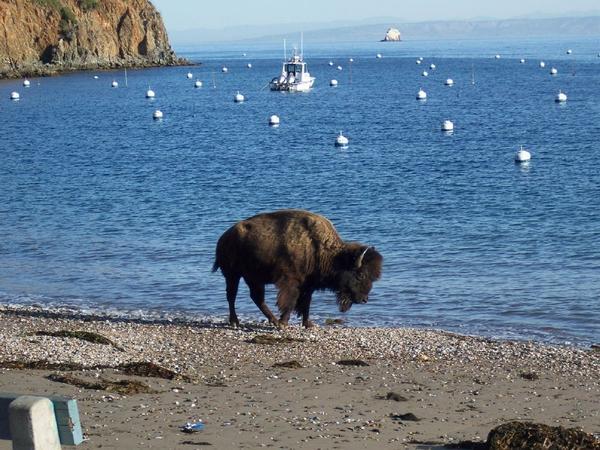
  • It has a herd of Bison left behind after a film was shot
  • The main town, Avalon has a 3rd Street, but no 1st or 2nd  Street
  • The local post office doesn’t deliver the mail
  • But the local cabs deliver pizzas

      You may know the island from the song ’26 Miles’, made famous by the Four Preps in 1958.  I’m warning you right now, if you remember the song and you go to Catalina, that song will be playing in your head – THE WHOLE TIME YOU’RE THERE!  I believe that’s called an ‘earworm’ – it felt more like ringworm.  Like most people my age, I remember some of the lyrics to the song, but not all of them, so I ended up humming the words I didn’t know.  Out of frustration of this song being on ‘replay’ in my head for three days, I decided to look up the real lyrics.  It is said that the cure for earworm is to finish the song and I couldn’t finish the song until I looked up the actual lyrics.  So I did.  I was not surprised to find that these 1950 classically banal lyrics were . . . well, classically banal as well as factually inaccurate, starting with the title.

Catalina Island is 22 miles from Los Angeles, 33 miles from Long Beach and 34 miles from Newport Beach – it is not 26 miles from any port.

Water all around it everywhere’ – Isn’t this a little superfluous?  Isn’t an island, by definition, a land mass that has water all around it – everywhere?

‘I’d swim with just some water wings and my guitar’ – The song was written by Four Prep members, Bruce Belland and Glen Larson, two mature Southern California young men.  I think we get a clue to their desperation when they suggest that they’ll swim 26 miles (or whatever) to find romance and that they’ll use water wings to do so.  Two men swimming to Catalina with water wings really doesn’t call up an image of the kind of men women would be looking to hook up with, even in the 50s.  But if for some reason they were not able to navigate the 26 miles in water wings . . .

I can leave the wings but I’ll need the guitar for romance.  This seems to suggest that if their little sister had borrowed their water wings for the weekend, they could leave them and use a guitar to get over to the island.  Acoustical guitars are made of wood and can be fairly buoyant, and perhaps even act as a floatation device, but the guitar would have been rendered unplayable after upwards of 8-10 hours in salt water.  So these ‘Preps’, who apparently were striking out with women at home, were probably not going to have much better luck on Catalina.

I’d work for anyone even the Navy, who would float me to my island dream . . .   This plan seems a bit half-baked and completely irrational, but that really doesn’t surprise us at this point, does it?  Joining the navy would probably mean a four-year commitment and training who knows where.  After basic training their chances of getting deployed to Catalina would have been non-existent.

Forty kilometers in a leaky old boat, any old thing that will stay afloat   Finally the boys have the right idea here by looking into a boat; the fact that they’d settle for one that is old and leaky speaks volumes about their nautical acumen.  Why they’ve switched to the metric system for measurement here I’m not sure, but forty kilometers is equal to a little more than 24 miles, still leaving them far short of their chosen destination.

While looking at the logic of the lyrics was a bit unsettling, finishing the song did indeed rid me of my earworm.  How was Catalina?  Very enjoyable, so enjoyable in fact that I’m headed back there to spend the New Year’s weekend – at that time I’ll try to give you more of a flavor for the island itself, assuming I can get that damn song out of my head.

 PS: I actually like the song and The Four Preps

THE UNDECIDED

By Suzanne Sparrow Watson

We’ve been hearing a lot the past few weeks about the “undecided” voter in the presidential election. At this point it seems that most people have made up their minds about which candidate will screw up the country for the next four years. But there remains a significant percentage of people who are unable to make a decision, even though there are pretty big differences between the two candidates. The other night a major broadcaster was skeptical that anyone could still be undecided. He obviously does not work with the public.

Nine years ago, after retiring as a bank executive, I decided to take a job one day a week doing something fun. So I signed on at the local yarn shop. I hadn’t worked with actual customers since college and, for the most part, it’s been fun. The average client walks in, chooses a pattern and some yarn, and walks out happy. Sometimes a person asks for help and after a few basic questions the right project is selected.  It’s all done within 30 minutes.

But then we have the “undecideds”. They typically walk in and say “I have no idea what I want to make.” Okay, I’ll say, let’s narrow that down – a sweater, hat, golf club cover? Perhaps some steel wool so you can knit yourself a washing machine, I joke. But I am speaking to the wall. No pattern is quite right, no texture is appropriate, no color just the right shade. The quandary over a skein of yarn is beyond comprehension. A long time ago my brother, Jack, taught me this: the important thing about a decision is to MAKE one.

My favorite example of an “undecided” was when a tourist came in one day, completely befuddled. She asked me if I had a yarn that would match her brown coat. She somehow assumed that I would know exactly what her brown coat looked like. I wanted to say, “Lady, I don’t even know you, much less your brown coat”. But after an hour of searching for yarn, gnashing of teeth (me) and tentative murmurings (her), she made a selection. I’ve often wondered if the brown coat was happy.

I really worry about these people once they leave the store. If they have this much trouble picking out yarn, how in the heck to they make more critical decisions? I shudder to think of these people picking out something more permanent, like carpeting. The texture selection alone must give them the vapors.  Colleges for their kids?  They must have to start when they’re in kindergarten to reach a decision in time.

But you don’t have to work in a yarn store to experience these people. They are the ones in the front of the line at Starbucks, completely undone by the choices. Tall or grande? Foam or whip? The choice between bold or mild is enough to send them into an apoplectic state. These unsure souls are the reason that the wait is usually interminable.

So, back to the election.  Apparently in some states there are so many “undecideds” that the whole darn state is considered to be a “swing” factor in this election. As far as I’m concerned these people are getting what they deserve: a barrage of negative, mean-spirited campaign ads. But I have news for the campaign managers. If an “undecided” can’t choose between red or blue yarn, choosing a President of the United States is a reach beyond their grasp.

THE UPSIDE DOWN BUCKET LIST

by Suzanne Sparrow Watson

     Every time I pick up a newspaper or a magazine lately it seems there’s an article about someone working on their “bucket list”.  Boomers everywhere are compiling lists of things to do before they die: climb Mt. Everest, sail around the world or buy a red Corvette.  My brother has done an admirable job of checking off his “to do” list; most of his feats require a lot of conditioning and some derring-do.  Except seeing the General Patton Museum – that just took a high tolerance for boredom.

     I used to have a bucket list.  Actually, it wasn’t so much a list as an item.  I only had one thing I wanted to do – hang glide.  For thirty years I’ve watched hang-gliders with admiration. I was in awe of their fearlessness and their obvious gold standard medical plan.  But in the last year or so I’ve finally come to the realization that I won’t be jumping off a cliff anytime soon.  For a while I thought I might take a page from George H.W. Bush’s skydiving book and go tandem.  Now I’ve decided that unless I get that same cute Army Ranger to hang on to, it’s just not going to happen.

     So earlier this year I decided to flip things around.  Instead of a bucket list, I started to compile a list of the 10 best events that I have already experienced.  In other words, I started an Upside Down Bucket List.  My only rule was that nothing on the list could be “obvious” – like a wedding day.  Given that I have a hard time remembering what I had for dinner last night, it has taken me months to recall 10 events worthy of the list.

     I started off with five items that were major moments.  Those were easy.  The next five took more thought and retrospection.  I was surprised when something as mundane as a movie or listening to someone else’s adventures would spark a memory of something I’d long forgotten.  I would jot down events as I thought of them and then mull over whether they were worthy of the final five slots.  It was lost on me that no one else was ever going to see this list – my obsessive/compulsive nature took over and I needed it to be perfect.  Perhaps one of my activities should have been to visit a good shrink.

     Of course, dredging up memories causes some not so great days to be recalled too.  Like the time I fell down an entire flight of escalators at a BART station (everything in tact except my dignity) or when I walked in late to a wedding and realized after 10 minutes that it wasn’t my friends’ wedding (ever tried to skulk out of church quietly?).  Those days definitely did not make the list but for a moment I did think about compiling a list of my 10 most embarrassing days.

     After months of thinking and reminiscing, I have finalized my Upside Down Bucket List.  Final for now anyway; I’ve reserved the right to add and delete as my memory allows.  It’s interesting to take a step back and review it.  I’m not sure exactly what it says about me, but my list divides into three categories:  Adventure, Family, and Personal Achievements. I won’t bore you with the list but I can assure you that each item brings back great memories – whether it was challenging myself physically, a great conversation with my dad, or an unexpected success.

     It’s been a fun experience.  It was harder than I thought it would be but it also more rewarding.  Each time I look at the list it brings a smile to my face or a boost to my confidence.  So I’d encourage you to do it – it’s a great way to remember the good times.  And a lot safer than leaping into thin air with some flimsy wings strapped on your back.

Death Valley – Why?

by Bob Sparrow

    When I told people that I wanted to go to Death Valley, they asked why?   I wasn’t really sure.  I had heard that it had recently reclaimed the honor of the hottest place IN THE WORLD, wresting the title from Libya – 134 degrees!  As I prepared to make the trip I knew from watching the temperatures that it wasn’t going to be that hot, but I wondered what life in Death Valley under such extreme temperatures was like.  I thought it would be interesting to write about the extreme heat and how the flora, fauna and humans survived it.  I thought I’d be using the term ‘buzzard hot’ many times.  I was even going to bring an egg along to fry on a sidewalk.  To be honest, I thought I would mostly make fun, or at least make a number of ‘hot jokes’ about this seemingly god-forsaken place.  Those who have been there know the reality I was about to learn.

     I hit the road at 5:00 a.m. and got into Baker at 7:30.  I used to think that Baker was in the middle of nowhere, until I turned onto Highway 127 and headed north – Baker became a thriving metropolis.  After driving less than an hour, I thought I was in that giant warehouse in New Mexico where they filmed the ‘fake moon landing’.  There was nothing in the distance but Mojave Desert for as far as the eyes could see – no other cars, no road signs, not even a shoulder on the road, just a narrow two-lane road winding through the desert.  It’s a place where you really have to trust your car not to break down.

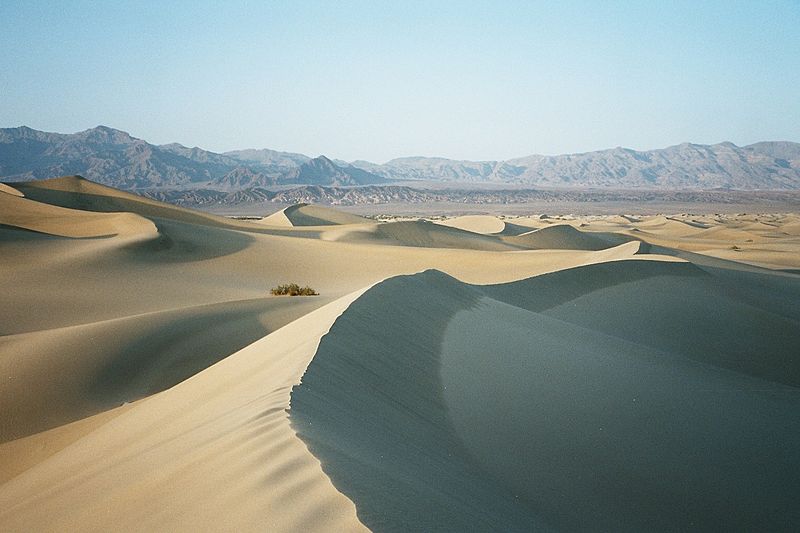
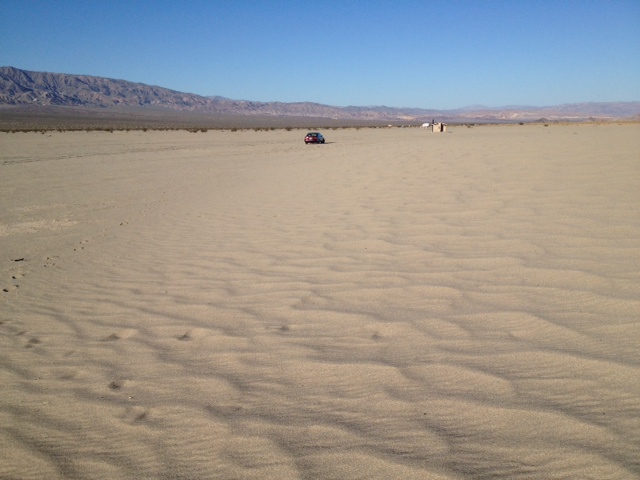
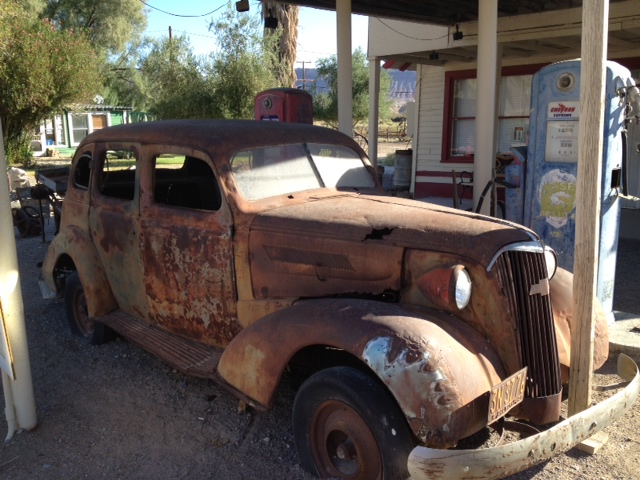
     I soon came upon Dumont Dunes (left) – real live sand dunes, just like you see in the movies, but without the camels.  My car is not an All-Terrain Vehicle, but I pretended that it was and drove off the road to get a better look at the dunes. (photo below, yes that little speck is my car).  At the junction of Highway 127 and Highway 190, I arrive at the bustling burg of Shoshone, population 31, I didn’t see one of them.  I was hoping to get gas here, but as you can see from the picture below, the car in front of me was taking quite a while to fill up, so I moved on .

     As I got closer to Death Valley the names of the towns and points of interest reminded me of just how hot it was getting outside – Furnace Creek, Hell’s Gate, Dante’s View, Stovepipe Wells, Charcoal Kilns, Burning Wagon Point.  I arrive at the Death Valley Visitor Center to get recommendations for what I should see and do.  At the top of the list was Scotty’s Castle (top photo) – another 50 miles to the north.  I got back in the car and got back on the road – it was 11:00 and the temperature just broke 100.

     The story surrounding the building of Scotty’s Castle in the middle of nowhere is a fascinating one.  Built in the 1920s, this architectural wonder featured a one million gallon swimming pool, an elaborate heating and air conditioning system which was way ahead of its time, an innovative hydro-electric power system driven by a desert spring that still delivers 300 gallons of water per minute, AND a solar panel, yes a solar panel built in the 20s!  Just as interesting as the house itself is the story of the two key characters responsible for its construction – Albert Johnson, the wealthy, Cornell educated engineer who longed to be a ‘cowboy’ and Walter Scott (Scotty), a con man who left home at the age of 11, moved to the desert as a teenager and eventually started selling shares of bogus gold mines to wealthy easterners, Johnson being one of them.  How they formed a life-long friendship is something you’ll have to read on your own.

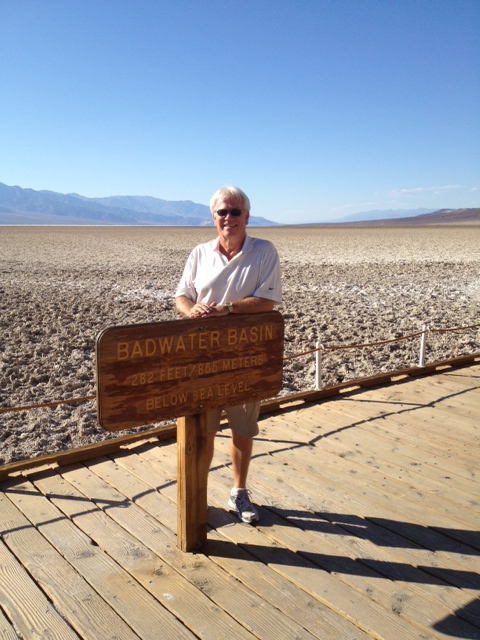
      After Scotty’s Castle I had to get to Badwater; it’s just a field of encrusted salt, but it’s the lowest place in the Western Hemisphere – 282 feet below sea level.  Part of the reason I wanted to get to this historical location was just to breathe the air; I thought if high altitude creates thin air which is hard to breathe, then low altitudes must create ‘thick’ air – which logically would be easier to breathe.  I’m here to tell you I couldn’t tell the difference between sea level air and below sea level air.

     My most memorable drive was coming back from Badwater; a loop off the main road appropriately called Artists Palette, it is a narrow, one-way drive cut through the mountain that shows colors you’ve never seen before – it is surreal.  It underscored to me the most surprising part of my desert experience – the sheer beauty of the place, and I was told that the springtime is really beautiful.  Everywhere I drove there were beautifully colored mountains on each side of me – chocolate brown to cream-colored, cobalt blue, sage green, every shade of red and orange.  And they all changed hues from sunrise to sunset.

      I then drove out to Zabriskie Point just before sundown and my photos just don’t capture what one feels when taking in everything that nature has done to this terrain.

     Death Valley – why?  The shapes, the textures, the colors can be seen nowhere else on the planet; it should be renamed the Painted Desert – it is truly magnificent.

Papa Hemingway’s Place

20120918-061523.jpg

By Suzanne Sparrow Watson

Each year my husband and I think about where to spend our vacation. We gather brochures, drool over pictures of exotic places and then end up going to Sun Valley, Idaho. Each September since 1988, like lemmings to the sea, we return to that idyllic spot. Mad cap adventurers we are not.

We used to beat ourselves up about this – we should see more of the world, yadda, yadda, yadda. But each year when we arrive in Sun Valley a great sense of peace comes over us and we know that we are in the right place.

Sun Valley is in some respects a typical resort town. You can buy lots of cheap t-shirts and baseball caps with bears on them. And the prices? Definitely aimed at tourists. It took Starbucks 10 years to get a permit to open here and it remains the only “chain” in town. If you can’t live without your Big Macs or Whoppers, this is not the place for you.

Celebrities flock here, in part because the locals are totally unimpressed with them. Visits by Tony Hawk and Lindsay Vonn cause more excitement than Bruce Willis or Bill Gates. The celebrities who come here are more relaxed and friendly than you might imagine. My husband once spent 20 minutes talking to Arnold Schwarzenegger about California’s tax problems in the local coffee shop. Obviously that was not a fruitful conversation.

Perhaps the celebrity most closely associated with Sun Valley is Ernest Hemingway. It was there that he relaxed, and wrote, beginning in 1939 until his suicide there in 1961. He holed up in a room at the Sun Valley Lodge to write arguably his best novel, “For Whom The Bell Tolls”. As one walks the hallways of the Lodge, there are numerous pictures of him hunting, fishing and, not surprisingly, drinking. Some of the bars he frequented in town are still in business; they are what would be colloquially known as “shit-kicking” saloons. It’s not hard to imagine him sitting in one of these dark corners, whiskey in hand, observing human behavior. It’s rumored that one night, well into his cups, he staged a mock bullfight down the middle of the bar.

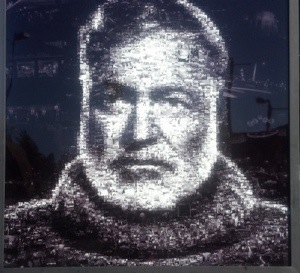
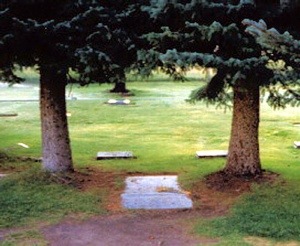
The picture shown at the top of today’s post is of a sign that sits at the busiest corner in town. It is comprised of 10,000 tiny pictures taken of Hemingway during his years in Paris. It overlooks the new town square and gives the impression that “Papa” is still participating in all the local festivities…and gossip. Further down the road is the cemetery where he is buried (pictured below). Aside from the occasional tour it is usually quiet, the only hint of traffic is the occasional flower or note placed on his grave from an admirer.

20120918-065049.jpg

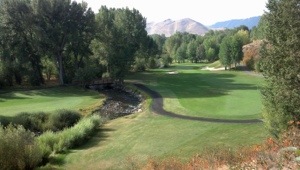
Our favorite Hemingway spot is the memorial that was erected in his honor, built just east of the Lodge in 1966. It consists of a tall granite base topped with a bronze bust of his head. It is perched amongst a grove of his beloved Cottonwood trees, overlooking the beautiful Trail Creek with the mountains in the distance. Here is a picture of his “view”:

20120918-072558.jpg

<;;;

It is inscribed with the words that Hemingway spoke at the funeral of a friend, but projects his own feelings as well:

Best of all he loved the fall,
the leaves yellow on cottonwoods
leaves floating on trout streams
and above the hills
the high blue windless skies
…Now he will be a part of them forever.

Whenever I read those words I feel justified in our trip there each September. After all, if it was good enough for Ernest Hemingway, it’s certainly good enough for us.

The Ascent of Half Dome – Not Your Average Walk in a National Park

The literature on the Half Dome hike reads as follows:

Difficulty:  Extreme. It’s long, steep at the beginning and end, and more dangerous than most Yosemite hikes. It’s probably the most difficult of all Yosemite day hikes. On the traditional 1 to 10 scale, this one rates an 11.

Insanity Factor: 9 out of 10.  Wait ’til you get to the cables, and you’ll see.

     I lie motionless in my sleeping bag in the still night air listening to the climbers miles away on El Capitan shouting back and forth to each other as they are suspended thousands of feet up on the face where they have clamped their ‘bat hammock’ into the granite face for the night.  My alarm goes off at 3:30 a.m., but I’m already awake.    Although we all went to bed very early, none of us slept very well – we knew we had a big day ahead of us.

      We were on the trailhead at 4:00 a.m.; we gazed in awe at the black sky filled with billions of stars – it is an awesome sight, one we don’t get to see back home.  With miner-like hiking lights attached to our hats, we begin out journey.

      It’s a little over a mile’s hike from where we parked to the trailhead, from there it’s 6.2 miles to the top of Half Dome, our destination.  I attempted this same hike just last year, but because of the late and heavy winter, the infamous cables that must be used to climb the last several hundred feet to the summit, were down, so I could not get to the top.  The bucket list went unchecked, so I returned.

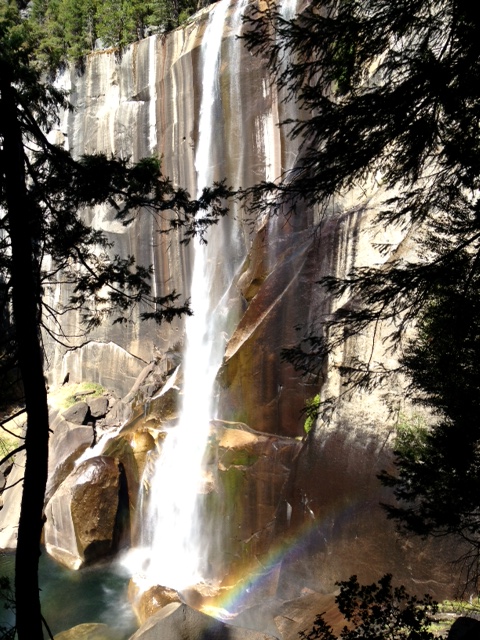
     Early in the hike we get to the extremely vertical granite ‘steps’ of Mist Trail along side Vernal Falls, one of the toughest part of the hike, compounded by the fact that our packs are heaviest with the 3-4 liters of water we are carrying, as there is no potable water along the way.  We reach the top of Vernal Falls and it’s still dark as we head towards the base of Nevada Falls, but after about 20 minutes, we realize we’ve lost the trail.  Scott has a GPS and gets us back on course.

     To me one of  the most beautiful parts of any hike is when you’ve hiked in the dark for several hours and then are able to experience the soft light of a sunrise filtering through the pines slowing bringing daylight to the mountains.  This soft morning light allows us to turn off our ‘head lights’ and enjoy the relatively flat part of the hike and then a gradual incline to the base of the ‘Subdome’.  The trail is relatively free of other hikers, in part because it’s after Labor Day and the tourists are gone, and in part because the recent hantavirus outbreak caused by rodents that infected eight visitors to the park this summer, killing three, has certainly discouraged some visitors.
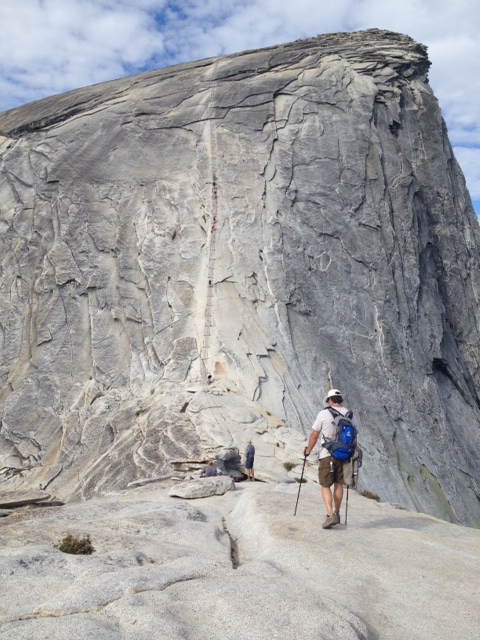
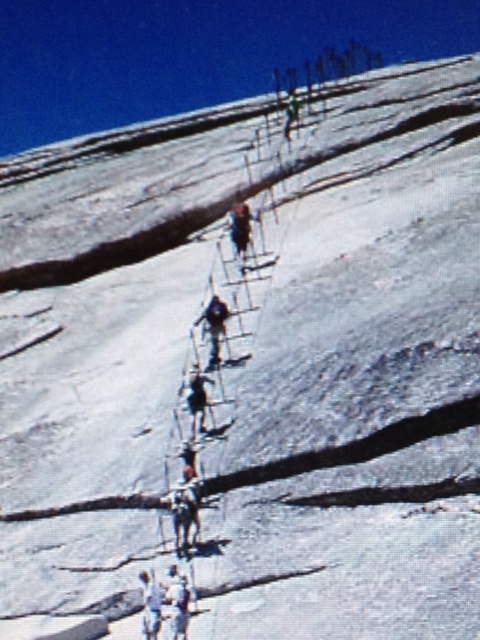
     We’ve been on the trail for about five hours when we reach the base of the ‘subdome’; climbing the subdome is arguably the hardest part of the hike.  It is a series of very vertical granite switch back steps, the heat of the day is apparent as is the fact that you’re at around 8,000 feet and air is starting to get a little thin.  We take our time and finally reach the top of the subdome; from there it’s a short hike down to the saddle between the subdome and the bottom of the cables and your eyes are on the cables the whole way.  There are about 5-6 hikers spread out at various stages on the cables, which look much more vertical than I remembered.  Perhaps it’s because I know that this time I’m going to have to climb them.

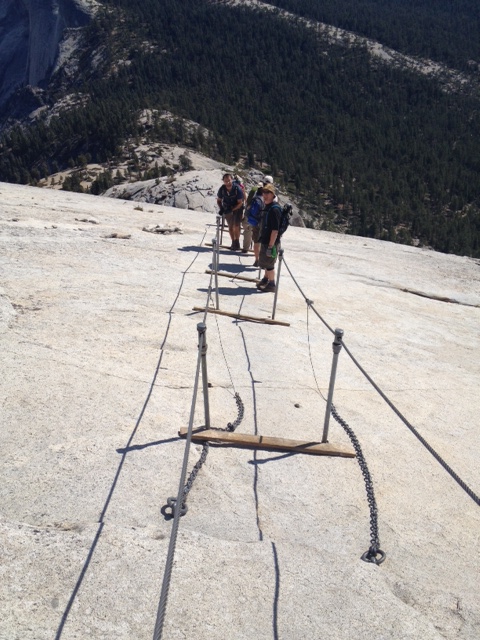
     We don our gloves, which are necessary for gripping the cable and pulling yourself up, and begin the final phase of the climb.  Because of generally fewer people on the trail and our early start, there is no one coming down the cables while we were trying to go up.  They say the cables are at a 45 degree angle, it seems more like 90 degrees.  Under the two cables, which are about three feet high, are 2 x 4s on the granite about every ten feet, where you can stop and rest, which we do.  It’s an opportunity to turn and look down at where you’d end up if you slipped.  You don’t want to spend too much time dwelling on that, so you turn around, keep your head down and your hands on the cable.

     The top of Half Dome is spectacular; at 8,835 it’s not that high, it’s not even the highest point in Yosemite, but the view beats any I’ve seen from much higher summits.  The area on top is surprisingly large, I was told that there is room for 17 football fields up there.  Maybe, but I wouldn’t want to go out of bounds on any of them.  I did crawl on my hands and knees and then my stomach to the edge of the dome to looked over and immediately crawled back.  Patrick, Jeff, Greg and I spent about twenty minutes on top, ate a small lunch and then headed back down the cables – maybe scarier than going up; I tried going down forwards and backwards – it was scary both ways.
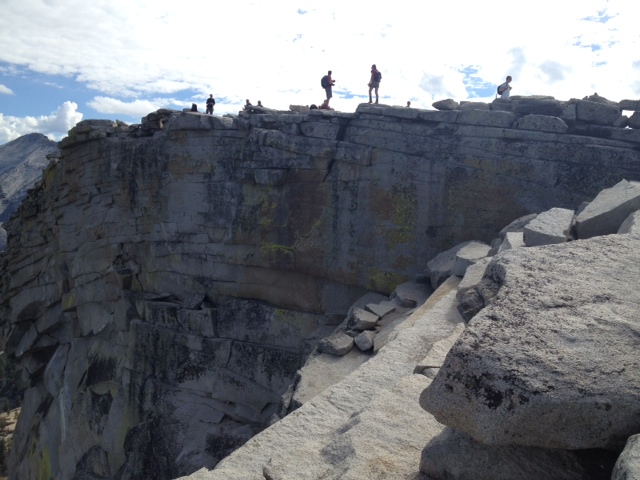
       Our return trip was high-lighted by seeing both Nevada and Vernal Falls in the light of day; the water levels were down, but still it’s amazing to just stand and look at these wonders of nature.  Eleven hours and 15 miles later we are exhausted and exhilarated . . . and home.
For those who haven’t seen the video I made of last year’s Half Dome hike, when the falls were spectacular, I’ve put the link below.

http://www.youtube.com/watch?feature=player_detailpage&v=gVBqw7nVz1c
HEY, SAILOR, NEW IN TOWN?

By Suzanne Sparrow Watson

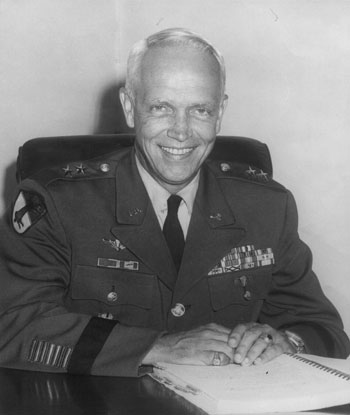
Last week my brother took us on an adventure – or lack of adventure – with an old Army general.  This week we’ll continue with the military theme and go aboard the USS Iowa.

My husband, Alan, brother Bob and I visited the “Battleship of Presidents” last month at its new home in San Pedro, CA.  Being a World War II buff, and always one to light up at the mere mention of Fleet Week, I thought this would be an entertaining way to spend an afternoon.  It was…just not in the way I expected.

When arriving at the harbor I looked around for a huge ship – after all, the Iowa  is a battleship, for crying out loud.  But as we pulled into the parking lot, I was still looking around for a big ship.  Take it from me; battleships are very low to the … well, sea.  I think I was imagining an aircraft carrier, which both Alan and Bob assured me are much taller.

In any event, once piped aboard we found that there are no official tours.  The Iowa had only been open for a month and the plan is to have guided tours within the next year.  Until then visitors follow painted arrows on the floor (or “deck” as they insisted on calling it).  Let me say right here that this is not a tour for anyone with any physical limitations; we climbed up and down stairs, stepped over those little barrier thingies between rooms, and had to squeeze through narrow passageways.  People with claustrophobia or who are on the heavier side of the scale should not plan their next summer vacation around a visit to the USS Iowa.

Nevertheless, the Iowa  is an impressive ship with an equally impressive history.  The Iowa  was in Tokyo Harbor on the day World War II ended and it provided the platform from which Reagan presided over the ceremony for the Statue of Liberty’s restoration ceremony. George H.W. Bush officiated at its recommission and sadly, at the memorial for 47 sailors who died in the accidental explosion of a gun turret.  It was home to many brave men and women who served our country and it now provides us civilians with a real appreciation for life on a battleship.

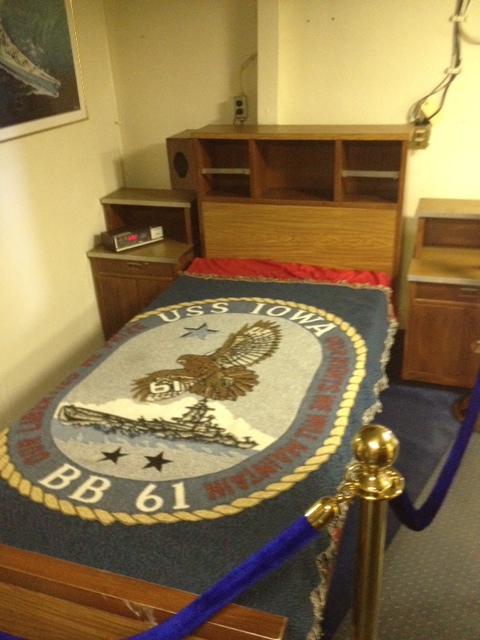
The photographs and artifacts in the officer’s quarters provided the most graphic history of the Iowa.  There was a giant map of the ship’s cruises, from its launching in 1943 to its decommission in 1990.  In 1943 it took FDR to Casablanca for the summit with Stalin and Churchill.  The captain, having a firm grasp of the organization chart, vacated his quarters and lent FDR his “luxurious” suite.  Here is a picture of the bed that Roosevelt slept in with the specially woven Presidential bedspread:

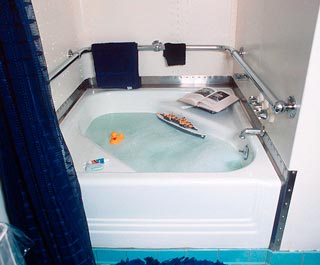
Due to FDR’s polio, the captain also installed a hot tub (pictured below) for that cruise.  This was a man who clearly wanted to progress up the ranks.

I’m thinking that Roosevelt didn’t actually play with that rubber ducky.  The visit to the captain’s quarters only confirmed that we have a long tradition of wasteful government spending in this country.

Moving on, we climbed endless steps up and down through the various compartments and decks.  Without a formal tour guide, I had to rely on the descriptions and explanations that Alan and Bob rattled off – two people who never let the truth get in the way of a good story.  I have no idea if even half of what they told me is true, but there were times when they were so animated that a crowd gathered to listen to their “expert” commentary.  The oft-used mnemonic for Iowa – Idiots Out Walking Around – came to mind.

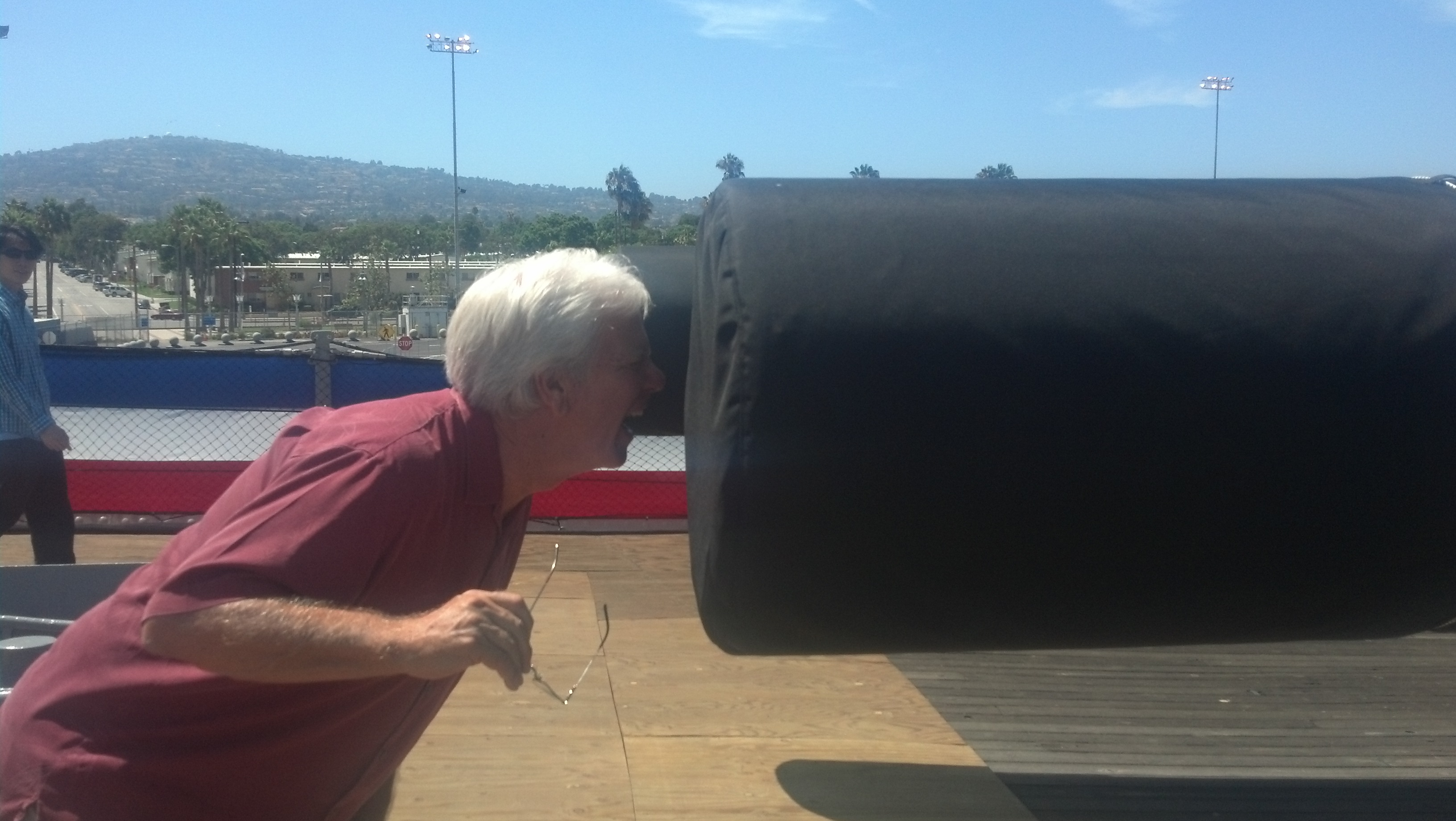
Here are the two of them – Bob not knowing which is the business end of a 16″ gun barrel and Alan showing off his guns.  You can see what I was up against.

Despite the Iowa  still being in shakedown mode, one facet of the ship was up and ready to go – the gift shop.  Not a trick had been missed in setting it up.  There were the requisite t-shirts and caps, of course, but they also sold golf ball markers, a Stryker marshmallow gun, and a book called “Airigami: Realistic Origami Aircraft” in case you’re looking to kill some time at your next staff meeting.

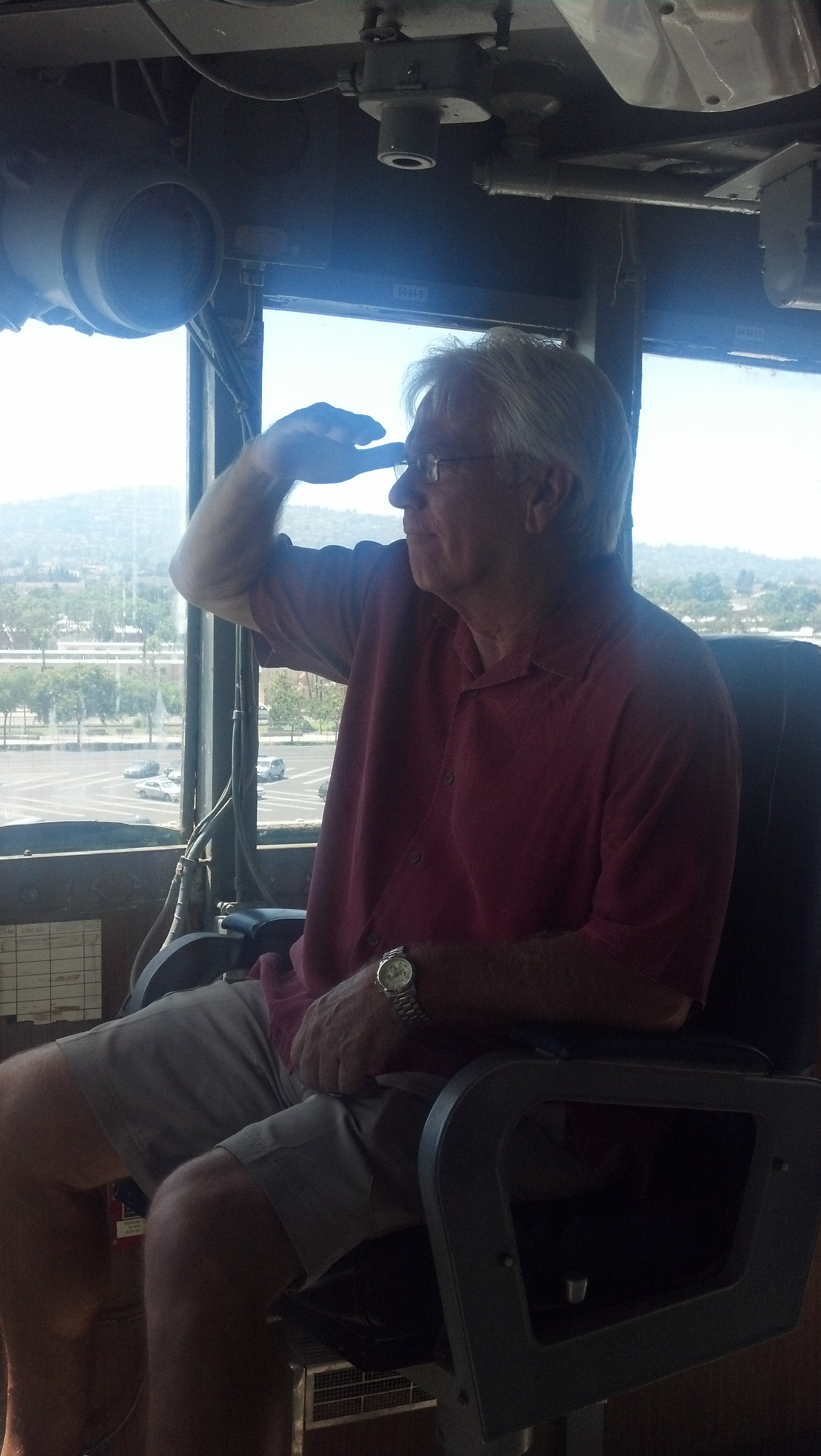
All in all, the  USS Iowa is well worth seeing, but my recommendation is to visit when they have their official tours available.  If you go before that, just make sure that the person up on the bridge doesn’t look like this:

The General Patton Museum – Tanks, But No Tanks (Part II)

by Bob Sparrow

The Museum

     I turned off the freeway and headed for the museum and see a statue of General Patton and his trusty dog, William the Conqueror, atop the museum as well as an assortment of tanks off to the left side of the single story building. I learned that this is not the ‘official’ Patton Museum; that is in Fort Knox, Kentucky, but since I wasn’t headed in that direction anytime soon, I figured I’d check out this ‘memorial’ museum, which is built on the site of the former Desert Training Center, in beautiful Chirico Summit, CA.  The surrounding environment is very hostile, which is why this area was selected as a place to train our armored division for battles in Northern Africa during WWII.  At the time Patton said,

 “If you can work successfully here, in this country, it will be no difficulty at all to kill the assorted sons of bitches you meet in any other country.”

     Back in the day, the Desert Training Center was 18,000 square miles, making it the largest military installation in the world; it opened in 1942 and at any one time there were upwards of 190 thousand men and 27,000 tanks/halftracks training at this facility, which was lovingly referred to as, ‘the place God forgot’.

     The website says that there is a ‘suggested donation’ of $5.00, but the lady at the door requires that you ‘ pay your donation’ or you ain’t gettin’ in.  To me, the museum was singularly unspectacular.  It’s got Patton t-shirts, miniature plastic tanks and ball caps with Army stuff on them all for sale; you can see some old uniforms, shell casings, pictures and stories about Patton’s war heroics, as well as the story of the infamous ‘slapping incident’ and the details of his freakish accidental death as a result of a car accident.  But some of the items, like a room with Holocaust photos and the story of Desert Storm and other artifacts, seem unrelated and appear to be just filler.  Even the pictures of Patton were disappointing.  Of course my image of Patton is really the image of George C. Scott – well, check out the pictures of each, who would you more likely follow into battle?

     So the real draw to the museum, I thought, must be the tanks.  I went outside into the oppressive heat and was first greeted by a friendly sign warning me of other ‘visitors’ who may be in the area – hope they paid their donation.

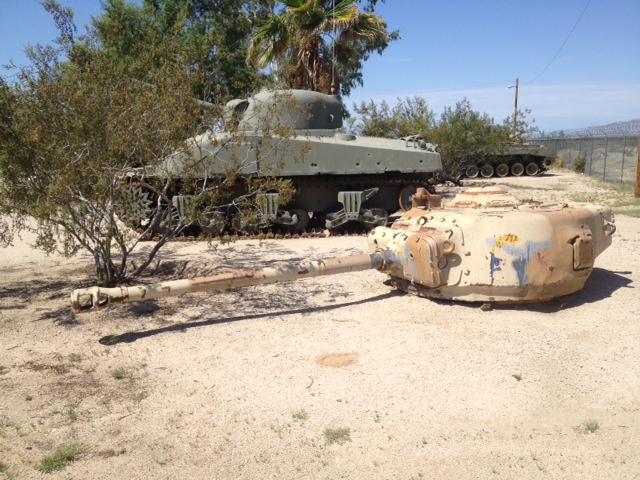
     There are 15 or so assorted tanks and halftracks sitting in the sand, mostly in disrepair, and looking like petrified dinosaurs stuck in the desert.  I thought it might be interesting to see the insides of a tank and perhaps sit in the driver’s seat – but the sign said ‘Do Not Climb On The Tanks!’  They were hot to the touch anyway and if it was 108 degrees in the shade, you could probably bake a turkey on the driver’s seat.


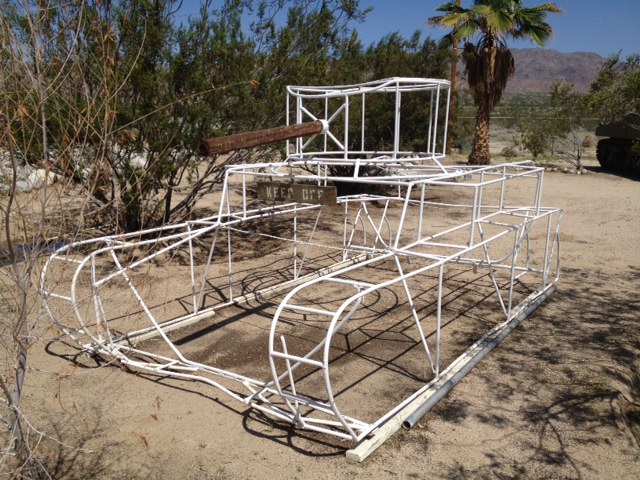
      There were also several ‘frames’ of tanks (see above right) which at first I thought were sort of like Jungle Jims that kids could play on, but there was a sign on them that said ‘Keep Off’ – so I guess they were just there to reserve a place for future tanks, not sure.

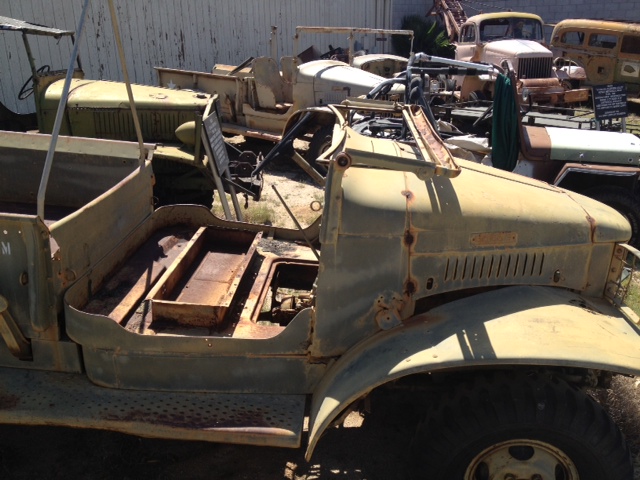
     Off in a fenced-in area there were more relics in severe disrepair, and I wasn’t sure if it was fenced off so they could charge extra to see these beauties or whether these would be on display at a later time, but as you can tell by the picture (right) it may not be worth another $5 to see them.

     So those of you who have seen the signs, wanted to turn off, but just kept driving, you and God were right, it is place that should be forgotten. Rent the Patton DVD and sit in your nice air-conditioned home and watch it. Great general, great movie, not-so-great museum.


The General Patton Museum – Tanks, But No Tanks (Part 1)

by Bob Sparrow

Interstate 10

   I was recently just leaving Arizona, where I had just learned that it is legal to carry a concealed or unconcealed weapon into a bar in that state – an experiment, I suppose, to see what happens when you mix fire arms and fire water.  That can’t have a good ending, but I digress.  Like many who have traveled Interstate 10 from Arizona to California, I have seen signs posted along the freeway for the General George S. Patton Museum, but never stopped.  Everyone I talked with who had driven that route said the same thing, saw the signs, never stopped.  So this time I decided to stop, but not before discovering some of the ‘treasures’ of the Mojave Desert along the way.

     Those who have driven Interstate 10 through this unpainted desert know that there is a lot of sand out there and not much else, but I discovered that if you’re really observant, you will see things that you won’t see anywhere else in the world.  For example, I noticed a sign along the freeway that read:  ‘Prison Near By – Do Not Pick Up Hitch Hikers’.  To me it really said: ‘Hey, we can’t be expected to keep our eyes on these crooks every second, so if one or two happen to escape and are looking for a ride out of here, don’t pick them up’.  Another amusing sign along the freeway asked me to turn off my air conditioning for the next ten miles to keep my car from overheating.  Are they kidding?!  It’s 108 degrees out there, what’s going to keep me from overheating?  Why don’t they just ask me to take off my dark glasses and stare into the sun?    Or maybe suggest that I stand out in the sun on the shoulder and help direct Armadillo across the freeway?

    The sights along the way, while they may be few and far between, are usually interesting and sometimes bazaar.  Pictured above, for example, is something you don’t see every day – a trunk hauling a ’54 Merc and . . . an airplane without any wings.  Where could they possibly be going?

     As I approached the ‘Agricultural Check Point’ coming into California – it’s where they check to make sure no fruits or nuts get into the state . . . Oops, I realized that I was eating grapes that I had purchased in Arizona and was now about to transport them illegally over state lines – a federal offense!  I couldn’t throw them out the window, that’s also illegal.  I approached to check point nervously.  When asked if I was carrying any agricultural items, I shifted the grapes to the side of my mouth and lied,”No sir”.  He waved me through.  I felt guilty, but I blame it on that hot desert sun – they say it makes you do crazy things, I believe them now.

     As I quickly drove away, constantly checking my rearview mirror, I saw a sign for the city of Desert Center, and thought I’d stop there, get gas, have something cold to drink, and get rid of the evidence.

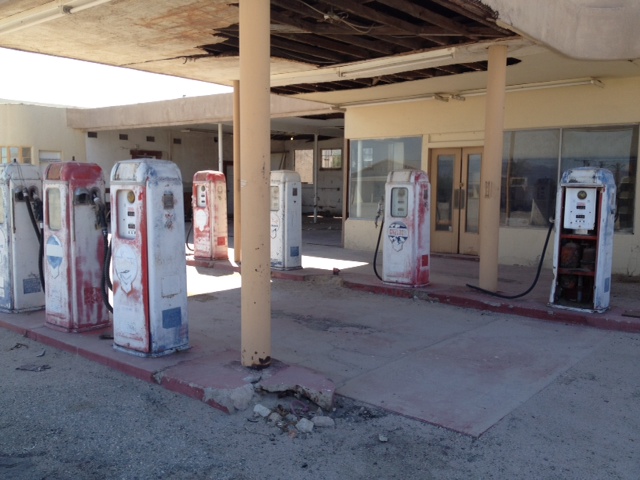
     I pulled into the gas station (pictured at right), but found it a little short on gas,  and everything else for that matter.  I started to go next door to the ‘Desert Center Cafe’ to get something to eat or drink, but found it closed – since 1987!  I drove over to one of the only other building ‘in town’ – it was an old school with an old tractor parked in the ‘Principal’s Parking Place’ (Below).

      It soon became abundantly clear to me that the best place to be in Desert Center was the center, because no matter which way you dove, you were leaving.

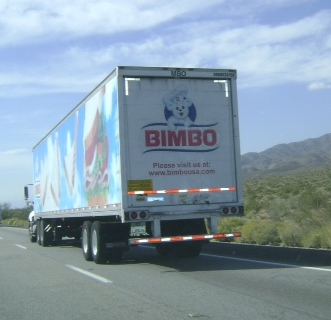
     Back on the freeway I did find one more interesting item on Interstate 10 before I finally got to the museum, it was a truckload of BIMBOS – headed for California.  

Thursday: The General Patton Museum – Tanks, But No Tanks (Part II)  I finally get there.