WHAT HAPPENS IN VEGAS…

By Suzanne Sparrow Watson

In 1962 I remember my parents and siblings being obsessed with “the draft”.  This was well before Vietnam, which turned the word “draft” into something to be feared.  No, my family was excited for the NFL draft, in hopes that my brother, Jack, would be selected.  He wasn’t.  Although he did sign as a free agent with the 49ers, who released him once they discovered he had broken his neck in college.  Even then, before the plethora of personal injury attorneys, the team knew better than to take that risk.

So, at a fairly young age I was made aware of the NFL draft and have had a waxing and waning interest in it ever since.  As a college football fan, I love to watch the draft when a player that I have followed is eligible to take part in the selection process.  It used to be that a player had to attend four years of college to be drafted, but now the superstars can be picked up after they are three years removed from their high school graduating class – so after their college junior year or their ‘redshirt’ sophomore year.  I used to have a problem with that, as I felt it discouraged the players from completing their education.  But I’ve come to realize that many of the superstar athletes are simply marking time in school and want to capitalize on their abilities as quickly as possible.  And no wonder.  The first-round picks in 2021 averaged $18.4 million, and even the players who fell to the seventh round eked out a paltry $2.7 million.
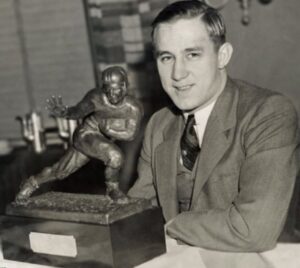
The draft, and the money, has come a long way from its humble beginnings.  According to the NFL, the first draft was held on Feb. 8, 1936, in a smoky conference room at Philadelphia’s Ritz-Carlton Hotel.  There were only 90 players in the selection pool.  The Eagles had the first pick and chose Heisman Trophy winner Jay Berwanger from the University of Chicago. Rather than play pro football, Berwanger, a star halfback, opted for a career as a foam rubber salesman. Berwanger’s choice wasn’t unusual — only 24 of the 81 players chosen in the first draft went on to play in the NFL. Most opted for more secure and stable professions, many of which paid better.

The draft, and the money, evolved in the face of competition — specifically the emergence of the upstart American Football League (AFL) in 1959. The competition between the new league and the NFL for draft picks was fierce.  Soon, the clubs employed “babysitters”, team operatives who were charged with developing relationships with college prospects, even before they were drafted, to make them more likely to sign with their club.  Teams from both leagues battled with each other for the star players, resulting in skyrocketing salaries for the rookies.  This competition continued until the two leagues agreed to merge following the 1969 season, leading to a common draft.

In 1980, the NFL Draft took its largest step forward when it was televised live. Commissioner Pete Rozelle was skeptical that the event would be a draw for fans but agreed that it could be broadcast on a new all-sports cable network, ESPN. Turns out, there was indeed an audience for the NFL Draft. The event has grown each year, eventually moving from that smoky hotel conference room in Philidelphia to the stage at New York’s Radio City Music Hall.  Last year more than six million people watched the draft on television.

This week the NFL will hold the first in-person draft since 2019.  It’s an understatement to say it will be an extravaganza.  For the first time the festivities will be held in Las Vegas, a town known for understatement and class.  Or not.  There will be an NFL Red Carpet Stage built on the Fountains of Bellagio, where the media will interview NFL Draft prospects during the event.  The stage will also host special performances by various Las Vegas entertainers and the players are slated to take a boat on the lake at Bellagio to the stage.
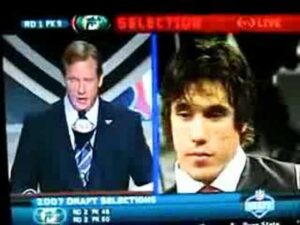
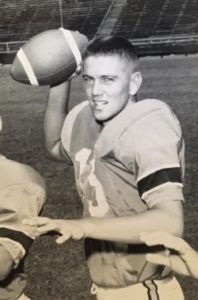
I’ll tune in this year, if for no other reason than to watch just how self-aggrandizing the NFL can be.  I’ll be hoping that we don’t have another moment like the 2007 draft.  That year Notre Dame’s star quarterback, Brady Quinn, was one of the few elite players invited to attend the draft in person, as it was expected he would be selected in the first or second round.  As the rounds went by, Brady was not selected.  When the tenth round was completed, and he was the only player left sitting in the waiting area, even the TV commentators were calling for mercy.  It became almost unbearable to watch, but as with a train wreck, it was hard to look away.  Finally, some sympathetic soul moved Brady away from the cameras.  He was eventually selected by the Cleveland Browns in the 22nd round.

One can only marvel at the money made by today’s players and the spectacle the draft has become.  We’ve come a long way from Berwanger choosing to become a foam rubber salesman.
The Bard by Any Other Name

by Bob Sparrow

Just a friendly reminder that there’s a special birthday coming up at the end of this week, on Saturday, April 23rd.  No, don’t worry that you only have a few shopping days left, he’s virtually impossible to shop for, plus . . . he’s dead.  Coincidently, he died on his birthday in 1616.  Yes, it’s my old friend, William Shakespeare.  OK, he’s really not my old friend, I’m old, but not that old!  Like most of us, I was introduced to ‘The Bard’ in high school.  I remember sleeping through class, as English teacher, Miss O’Brien, droned on about a guy who, I think, sold deer meat, called ‘The Merchant of Venison’.  I clearly wasn’t paying much attention during most of my high school years.  That fact was recently brought to my attention on a Zoom call with a number of my former high school classmates, a few weeks ago.  Our former student body president, Billy Dale Hall, who was on the call and reads our blog, said, in a most respectful way, something like, “I’m surprised that you write a blog, could you even write in high school?”  OK, maybe it wasn’t that respectful, but to his point, I could barely read in high school.

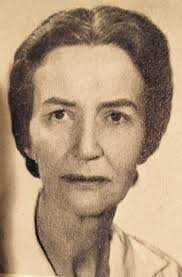
Dr. Viola Chapman

Fast forward to Westminster College where I was fortunate enough to ‘have’ to take a literature class from a Dr. Viola Chapman (Yes, in this photo she looks a bit like Norman Bates’ mother, but she was a really good teacher); fortunately, I had discovered a love of reading a year or so earlier, and in her class, I was learning to recognize and appreciate good literature.  Before I graduated, I had taken every class in English and American literature that Dr. Chapman taught, and ended up with a minor in English.  I was particularly drawn to Shakespeare because she made him so interesting.  Thank you, Viola!!

After reading most of Shakespeare’s plays and sonnets and visiting his house in Stratford-upon-Avon, England (he wasn’t home), I started reading things about how Shakespeare didn’t write Shakespeare’s plays and speculations about who might have.  Why, you ask, would anyone question the authenticity of William Shakespeare as the greatest writer in modern history?  Here’s a few bullets:

  • There’s no record of him ever attending grammar school, much less a university
  • Both his parents and his three children were illiterate
  • He writes intimately of kings and queens, yet had no access to the royal court
  • He wrote in detail about foreign places, but never personally left England
  • There was no public mourning at the time of his death
  • His will, which listed several gifts, did not include a single book from what would presumably be an extensive library

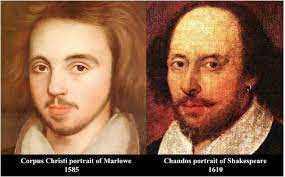
There’s more, but I think you get the drift here.  Those who have followed this ‘cold case’ for any length of time, know many of the likely suspects who might have or could have written Shakespeare’s plays.  My favorite is Christopher Marlowe, not because I think he’s definitely the one that wrote the plays, but because he has the most intriguing story.

Marlowe or Shakespeare                                      Who really wrote Shakespeare’s plays?

Marlowe was born in the same year as Shakespeare, 1564, but supposedly died at the age of 29, around the same time that Shakespeare started to write his plays. One theory is that Marlowe was a spy in Queen Elizabeth I’s secret service and his death, in a bar room fight, was faked to save his life and put him under cover.  After he went into hiding on ‘the continent’, he continued writing and sending his work to an actor/playwright broker in London named William Shakespeare.   Pledged to keep Marlowe’s identity a secret, Shakespeare submitted the plays with his own name on them.   It is also speculated that ‘Slick Willie’ collected plays from others who were high in the queen’s court and didn’t want to put their name on anything that might have jeopardized their position or their life!

For the lay person, the reading about ‘who wrote Shakespeare’s plays’ may be more interesting than the plays themselves, and for those of us who who even care about this, we hope that some day a ‘Rosetta Stone’ will be discovered that will solve this mystery once and for all.  In the mean time, our birthday boy, William Shakespeare, enjoyed a great life and an even greater after-life.  So I guess, All’s Well That Ends Well!


IT’S THE PICTURES THAT GOT SMALL

By Suzanne Sparrow Watson

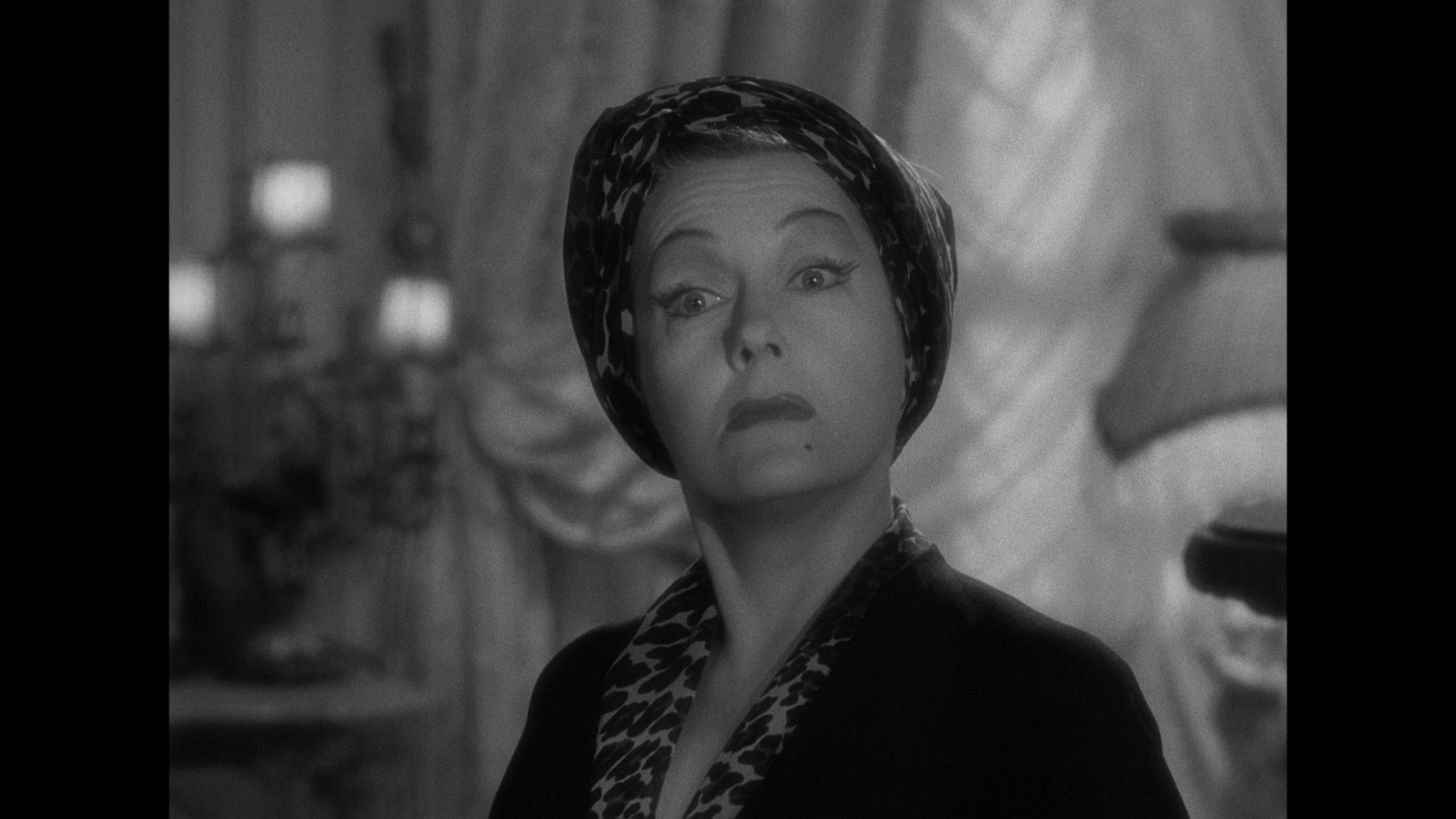
In the classic movie, Sunset Boulevard, a screenwriter meets an aging move star and says, “You’re Norma Desmond.  Once, you were big.” To which she replies, “I AM big, it’s the pictures that got small.”  Never has a more prescient comment been uttered, although I’m not sure Ms. Desmond or anyone else could have predicted just how small they would get.  Sunset Boulevard was filmed in 1950, when everyone went to movie theaters and movie stars were idolized.  Fast forward to 2017, The Hollywood Reporter estimated that movie attendance in North America was at a 27-year low.  And then 2020 hit.  No one went anywhere, much less to crowded movie theaters.  People stayed home, snuggled up in their jammies, baking bread and watched a streaming service.  Netflix alone added more than ten million subscribers in the second quarter of that year.

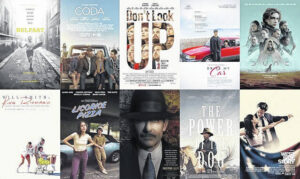
Movies, and network television, has been on a downward spiral ever since.  I’ll save my critique and frustration with television for another day, but the movies have been front of mind ever since the Oscar nominations were announced in February.  I recall a time, not that long ago, when everyone raced to the movie theaters to see all of the movies before the Oscars were awarded.  It was a communal way to connect – people predicting who would win the major categories, who would look the most glamorous, and who was snubbed.  Like March Madness or the Super Bowl, office pools and viewing parties were established so everyone who wished could be in on the fun.  But this year, when the nominations were announced, I lamented that I’d seen very few of the Best Picture nominees.  Worse, I wasn’t able to watch some of them because I don’t subscribe to the right streaming services.

Ten pictures were nominated this year and in order to see all of them you would need subscriptions to Amazon Prime, Netflix, You Tube, Vudu, HBO Max and Disney+.  Those subscriptions would cost you $115 per month.  What average family can afford that?  Apparently not many, because the viewership for the Oscar-nominated films is down again this year.  Partly because people don’t have every streaming service and partly because the movies are, well, terrible.  One Hollywood insider said that the movie studios are no longer making movies for American audiences because they make much more from international ticket sales, specifically in Asia.  Thus, the glut of Marvel action films.

Somehow, watching a movie from the comfort of my sofa is not as much fun as going to the theater, where everyone laughs, or cries, or screams in a shared experience.  Sure, it’s great to watch at home, close to Dash the Wonder Dog and my refrigerator, but watching on the small screen is not the same.  As Norma Desmond said, the pictures are getting small.  Little did she know in 1950 that they literally would go from a gigantic movie theater screen, averaging between 45-50 feet wide, to a 60″ television set (if you’re lucky).

It feels like we’re breaking up with the movies, or at least going out to the movies.  Like a lot of experiences from our youth, going to the movies is passe.  But looking on the bright side, there are a lot of good series to stream, and my sweatpants wardrobe is always in fashion in my living room.

Diamonds in the Desert

by Bob Sparrow

Diamonds in the Desert

Before desert temperatures reached the triple digits, we made two last treks to two different deserts in March to visit our diamonds in the deserts.

Our mid-March trip took us to some old haunts surrounding our Marriott Desert Springs Palm Desert timeshare.  Yes, there was plenty of golf, dining, and stories with the ‘Great Eight’ – the Budds, the Sagers and the VanBoxmeers (Linda and I would make eight in case you were wondering about the math!), but it was the other people we met, that live there, (at least part-time) that turned the trip from great to awesome!

Ed & Stacy Hunter at Indian Ridge

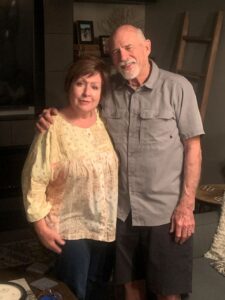
Diamond One!  We were invited to dinner at the home of Ed & Stacy Hunter, who live, during the winter, at Indian Ridge Country Club, a private golf club that has two magnificent golf courses and beautiful and immaculately kept grounds.  The Hunter’s home sits on a ridge with an amazing view of the golf course (the attached photo doesn’t do it justice).  Ed collects wine and whiskeys, and suffice it to say that we certainly consumed more than our share, but didn’t put a dent in his stash.  Stacy is the consummate hostess, serving an exquisite tray of charcuterie followed by a delicious dinner.

Diamond Two!  Two days later, we were invited for dinner at the home of Walt & Patty Schwartz, at Trilogy at the Polo Club in Indio, next to the Plantation Golf Club, which could be the subject of a future blog.  And while the view may not have been as grand, with Walt playing the consummate ‘straight man’ for Patty’s razor-sharp wit, the evening was filled with many stories and much laughter.  Oh yeah, and a magnificent charcuterie tray and another delicious dinner with plenty of wine.

Patty & Walt Schwartz

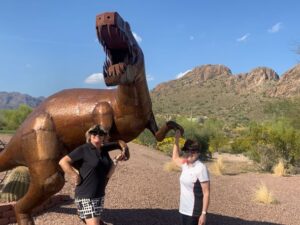
Linda & Starlet petting a dinosaur

Diamond Three!  Three days after returning from Palm Desert we set out for the Sonoran Desert, which includes much of Arizona.  Our first stop was Apache Junction, and a visit with Linda’s sister and husband, Starlet & Donnie Brummer.  Starlet’s daughter, Denise and her husband, Gene Cobb were also visiting from Minnesota and are always great to be around.  Friends, Bill & Kay Pompei, from Minnesota, who also spend the winter in Arizona stopped by for dinner and cards.  Kay provided me with several subjects for future blogs – thank you!  The following day, Starlet, Linda and I played one of the best golf courses I’ve ever played, Dinosaur Mountain at Gold Canyon.  Not only was the golf course magnificent, but the surrounding mountains and spectacular homes on the course were jaw-dropping.  A picture-perfect day made it the most enjoyable round of golf in a long time.  If you have a chance, play this course, you’ll love it!

Your co-writers

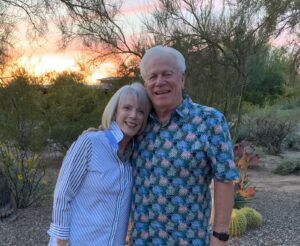
Diamond Four!  Four days into our trip we made our final stop at Scottsdale’s beautiful golf community, Desert Highlands to visit my sister and co-writer, Suzanne and husband, Alan Watson, as well as ‘Dash the Wonder Dog’. While Suzanne and I text, talk or email weekly, we rarely get a chance to see each other, so it’s always special when we get together.  When I explained to her that I was writing this week’s blog about our visits to our ‘Diamonds in the Desert’, and that our visit with them would be number four, she replied, “I hope you don’t label us as the ‘Cubic Zirconium’ visit!”  Not a chance!  We had a great time visiting and then dinner at their beautifully remodeled golf club house, as the sun set beneath a beautiful ‘Arizona red’ sky.  The perfect ending to the many facets of our visit to our Diamonds in the Desert.


FIRST WORLD PROBLEMS

By Suzanne Sparrow Watson

I recently played in our club’s big invitational golf tournament.  My partner and I won our flight and came in third overall.  But that doesn’t really tell the story.  She played brilliantly and I played like the dog’s dinner.  In fact, that may be an insult to canine fare.  My crowning achievement was picking the right partner.  I was despondent about my play and, having to participate in the “shoot out” in front of 100+ people to determine the overall winner, was horrifying.  But then a good friend sidled up to me and said, “Get a grip.  Think about the people in Ukraine.  This is a first-world problem.”

Of course, she was right.  Bad play in a golf tournament on a beautiful blue-sky day, surrounded by friends, is not something to complain about.  Most of us have lives that are filled with first-world problems.  I’ve heard people complain that their Wi-fi connection at the Ritz was too slow or the roast on their Tanzania Peaberry coffee beans was overdone. The term “first world” is actually an anachronism, since we no longer talk about the “third world”. We have shifted to the more optimistic phrase “developing world”.  Still, the idea of ridiculous first world complaints persist, and they seem particularly trivial in contrast to the horrors we’re seeing in Ukraine on the nightly news.

But for your amusement this Monday morning, and as some relief from the constant bad news, here are some of the first world problems I have heard lately:

  1.  My new iPhone 13 Pro Max doesn’t filter out spam calls
  2.  I can’t remember the password to my American Express Platinum card account
  3.  Neiman’s didn’t have the Christian Louboutin shoes in my size
  4.  I had to open a can that didn’t have a pull ring
  5.  My two-hour Amazon delivery was thirty minutes late
  6.  Why didn’t Amazon release the whole season of “The Marvelous Mrs. Maizel” at once?
  7.  My hotel in the Maldives didn’t have enough outlets in the room
  8.  I chipped my $80 ombre nail gel on the first day
  9.  My personal trainer took the week off to be with his kids on spring break
  10.  We had to fly to L.A. three times to get both of my mother-of-the-bride gowns fitted by Monique Lhuillier

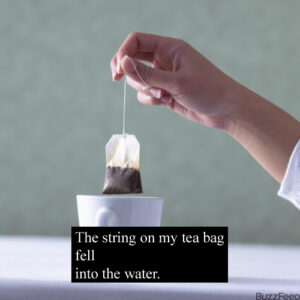
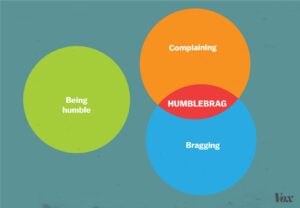
Then there are the “complaints” that are really something else: the humblebrag.  A humblebrag is defined as “an ostensibly modest or self-deprecating statement whose actual purpose is to draw attention to something of which one is proud.”  I think Facebook and Instagram have built their business models around humblebragging.  Parents of school-aged children are particularly good at it. Their posts usually go something like this: “I am so clumsy. I spilled Opus One all over the papers I need to sign to get Missy into the gifted program.”

Whether it’s just complaining about trivial problems or true humblebragging, we could all stand to put things into perspective.  That is easier said than done on the golf course, but it’s worth a try.

Five Minutes You’ll Never Get Back!

by Bob Sparrow

“Hey, a blog about nothing, this should be good!”

It’s one of those weeks where “I’ve got nothing”.  OK, another week where I’ve got nothing!  I am in the desert this week, but I’ve told you all about my escapades there, bad golf, fine dining and not-so-fine drinking, but plenty of it.  Let’s see, Russia-Ukraine, of course, has the headlines and everyone feels pretty much the same about the atrocities happening there. Covid is somewhere between ‘old news’ and ‘what’s the new variant” and the stock market is just a barrel of laughs.

I’ve been reading those ‘good news’ sites I mentioned a few blogs ago, and I find that I’m already bored with all good news.  On that subject, I’ve become less attracted to ‘Squirrel News’, but love Morning Brew, very entertaining If you sign up and tell them that I sent you there, they send me a tee shirt or a coffee mug, or maybe it’s just a tee shirt with some coffee stains on it.

I’m sitting here with a blank computer and a mind to match.  I’m thinking of Jerry Seinfeld’s television series, that he described as ‘a show about nothing’.  I’m wondering if I can write a blog about nothing.  I’m guessing that there would be a number of people out there who would say that I’ve written a number of blogs about nothing. 

Nah!

So, if you’ve got something important to do, nah, it doesn’t have to be that important, I’d skip the rest of this blog and go do it.  Ahh, wait a minute, here’s something.   I just discovered that it was exactly ten years ago from last Sunday that Suzanne and I abandoned our idea of writing poetic tributes.  Yes, some of you remember the old ‘Red Posey’ business that was augmented by our just-developed blog, All the News that’s Fit to Rhyme, where we followed a USA Today newspaper format by writing a topical poem about World News, Sports, Business and Entertainment – we published it EVERY WEEKDAY!!!  You can still find them at the beginning of our archives on this site.  From a financial perspective, the business failed, but what we found out was that Suzanne and I enjoyed working and writing together, so on March 20, 2012, we had apparently run out of words that rhyme and launched a prose version called ‘A Bird’s Eye View’, which we had to immediately change to ‘From A Bird’s Eye View’ because A Bird’s Eye View was already taken.  Originally, we posted twice a week, but somewhere in the middle of 2012 we transitioned to every Monday, sometimes twice a week if we’re traveling to an interesting place.  The blog’s been posted weekly, without fail, since then. We’ve posted somewhere around 600 blogs and have received over 4,000 comments, although I’d have to admit that the majority of those comments came from the same two people – thanks Pam and Janet!

As I’m fretting over what to put in the blog this week, Linda says, “Why don’t you just skip a week?”  I look at her like she’s got two heads and remind her that Suzanne’s and my father was a newspaper man, so it’s just in our blood not to miss a deadline.  She shrugs like she doesn’t really understand, so I try to bring it home to her and say, “Your father was a dairy farmer, so did he ever decide not to milk the cows for a week, or for a day, or for a morning?”  She had walked away by then, so I’m not sure she got the point, or was interested in the point.  So, I’m still rambling here.  Hey, this week is the first week of spring, which doesn’t mean much to those of us in southern California, since we’ve already had days in the 90s, but for those in the northern environs it will mean warmer weather and for all of us, longer days; well, technically the days we still be 24 hours, there is just more daylight.

I’m reading a really good book, The Beatles, remember them?  It’s by Bob Spitz and it starts from the very beginning – really a detailed commentary on everything Beatles – very interesting.  Unlike this blog!

TIPS FOR STRESSFUL TIMES

By Suzanne Sparrow Watson

Two years ago, on March 17th, 2020, I was at a dinner party with five friends.  COVID, or as we said at the time, “a new flu”, had just started to take hold in the U.S.  One friend asked, “What do you think we’ll be saying about this flu in two weeks?”  We all agreed that it would peak and that by the end of the month things would be back to normal.  Turns out that we were only off by two years.  It’s been a stressful two years: important family gatherings were missed, friends died, and, in general, people became crabbier.  A couple of weeks ago, just when life seemed to be back to normal, Putin decided to invade Ukraine.  So now we wake each day wondering if World War III started while we slumbered. The images and stories coming out of Ukraine are horrifying.

We’ve all been through a lot, so I thought this week I would offer some stress management advice and, hopefully, bring you a chuckle or two.  God knows we need it.

Stress Management Tips for 2022:

Stop being on time.  The more you care about being late, the more you stress.  So stop caring.  If you lose your job, so much the better.  Jobs are stressful.

Drink alcohol.  You can’t stress about stuff if you’re drunk.  So go ahead and grab that bottle of tequila and drink away.  Aim for being inebriated 60% of your waking hours.

Yell at people who don’t deserve it.  If you have followed step 2, this should come pretty easily.  Never take responsibility for being a jerk.  Accountability only makes you more anxious.

Pare down your possessions. This is essential.  You no longer have a job and you have an alcohol addiction to support.  See if you can fit all of your belongings in a backpack.

Spend more time outdoors.  Without any means of income, this is good preparation for your future living arrangement.  You are mere steps away from living under an overpass.  You will alleviate any pressure to work or pay rent.

Make new friends.  Ask strangers for their spare change.  By now you have no job, no house and your tequila is running low.  You’d be surprised how many people will throw a dollar bill your way.  Hold up a sign that says, “Need money for gas” and you might double your income.

Finally, if all else fails, I have two tips.  First, eat cake.  Yes, that is my remedy for every problem, but there is nothing like a good sugar high to make you feel better.  Second, learn to handle stress like a dog: if you can’t eat it or play with it, pee on it and walk away.

My prediction is that in two weeks the world will have calmed a bit.  I hope I’m a lot more accurate this time.


Time, Space and the Dinosaurs

by Bob Sparrow

Sputnik

I have been fascinated with space from an early age, and as I have mentioned in previous blogs, my teachers always referred to me as the kid who just took up space in school, but that’s another story.  Most who read our blog are part of the generations who have eye-witnessed the exploration of space first hand.

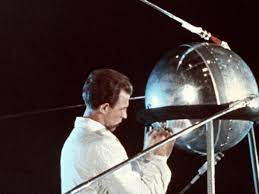
We remember the Russians, back then it was the U.S.S.R., as the first to explore outer space, as opposed to today’s Russian heart-breaking exploration of Ukrainian space. They opened the ‘space age’ in 1957 with the first satellite to circle the earth, Sputnik, which translated from Russians, means ‘satellite’ – hey, it’s not rocket science . . . well, actually I guess it is!  (Note how small Sputnik is in the attached photo).  A few weeks later, they were the first to send a living creature into space, a dog named Laika, but typical of the Russians, they neglected to send ‘poop bags’ with him, so he returned quite messy.  Subsequently, Americans feared they were falling behind in the ‘race for space’, which we were, so after two mulligans, we finally launched a satellite, called the Explorer, into orbit in January 1958.

In 1961 the Russians etched another notch in their ‘space belt’ by being the first to put a human in orbit around the earth, Yuri Gagarin, which in Russian translates to ‘Neener Neener’.   The Russians had a few other ‘firsts’, one of them being sending the first woman into space, although some say she has still not returned.

“One giant leap for mankind”

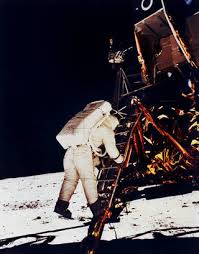
President, John F. Kennedy in May 1961, in an effort to put an end to Russia’s dominance in space, made a speech that challenged our scientists to land a man on the moon (and get him back safely) before the decade was over.  While most of our generation remembers where they were when they heard that Kennedy had been assassinated, we also remember where we were in 1969 when we watched Neil Armstrong deliver on Kenney’s promise, and walk on the moon, as well as proving, once and for all, that the moon was not made of green cheese (it was a rumor at the time, kids!).

Clearly the moon landings have been the biggest event so far in human space travel, but since then the launching of various satellites and telescopes that enhance communication and observation, as well as explore other galaxies have taken over the headlines.  In 2017 I wrote here about the satellite Cassini, that took nearly seven years to traveled over 4.9 billion miles to Saturn, made nearly 300 orbits of the ringed planet, took over 450,000 photos (Not all of them got Saturn smiling) and then crashed into the planet that it knew so well, and remains there today.

70 x 46 feet. The sunshield is the size of a tennis court

The next big thing in space happened in 2003 with the launching of the Hubble Telescope, which has provided astronomers with countless new observations about the vast regions beyond our solar system.

And now, we have the James Webb Space Telescope, which was just launched in December of last year (2021), and has now reached its final destination about a million miles from earth, where it will now orbit around the sun.  To say the least, astronomers are giddy!  Why?  Because with this giant telescope we can see further back in time than ever before.  OK, if that statement just made you shake your head, here’s a quick study on the space-time continuum that even those who didn’t take up space in school should be able to grasp. Light is not instantaneous, even though it seems that way when you turn on a light switch, but it is really fast; it travels at a speed of 186,000 miles per second.  OK, you still with me? The moon is our nearest celestial body in the universe, a short 238,900 miles away, it takes light about 1.3 seconds to travel from the moon to the earth, so we are seeing what the moon looked like 1.3 seconds ago.  Expanding that same logic, the Virgo Cluster of galaxies is the largest

I think that’s me in there somewhere!

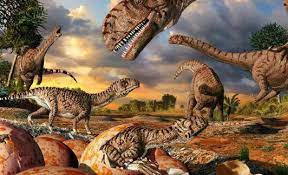
nearby collection of galaxies at about 60 million light-years from the Milky Way. Still with me? The light we see today from galaxies in the Virgo Cluster started on its path toward the earth at the same time as the age of the dinosaurs was ending on Earth. So, if you were in a Virgo Cluster galaxy today, and you had a telescope powerful enough to study the Earth, you would be able to see the dinosaurs roaming the earth.  What?!!!  Yeah, I don’t fully understand it either!  But I’m thinking that perhaps one day they will be able to figure out how some of us old dinosaurs that are roaming the earth today will be able to actually travel back in time!  Naah, I’m not sure I want to relive all that all over again!!

It is mind-boggling, but so fascinating for those of us that are still just taking up space.


ALL WORK IS HONORABLE

By Suzanne Sparrow Watson

In 2004 I was watching Hardball, the show formerly hosted by Chris Matthews, when his guest for the evening was Donna Brazile.   Ms. Brazile was coming off an unsuccessful stint as Al Gore’s campaign manager and at that time was the chair of the Democratic National Committee’s Voting Rights Institute.  On that episode of Hardball, she was asked about Tom DeLay, who was the House Majority Leader.  DeLay had made millions in the pest control business before entering politics (where he no doubt made millions more).  She made a derogatory comment about DeLay being “just a pest exterminator”, which in her estimation made him unequal to his task.  Matthews stopped the interview and told Brazile that being an exterminator was honest work and that in his religion “to work was to pray”. Matthews also noted that DeLay had been a successful exterminator while she was a failed presidential campaign manager.  He finished by saying, “There is honor in all work.”

I couldn’t agree more with that sentiment, which is why I am a bit befuddled by the high number of job openings in this country.  Work is good, and there is nothing like the satisfaction of doing a job well.  There are innumerable articles that have been published over the years about the benefits of working and they mostly boil down to a few things.  Work provides structure.  When all else is falling apart, it is good to have a place to go every day that provides stability.  A workplace can also provide friendship.  Sometimes it’s our friends at work that make a job bearable, especially when the boss is a jerk.  Nothing better than having a common enemy to bring people closer.  Work also provides money.  This seems obvious, but for anyone who has ever wondered how they are going to pay rent or buy food, a good job is invaluable.  When basic needs are taken care of a job can provide the cash to do fun things, like planning a vacation away from work.

If you are fortunate to find a job that you love, and that gives you opportunity to expand your horizon, work can go a long way toward a positive sense of self and becoming expert in your field.  Personally, I love watching people who are good at their jobs, whether it’s the street cleaner or a mechanic.  There is a poetry in watching skilled hands do what they’ve been trained to do.

So why are so many people choosing to stay home?  And how in the heck are they supporting themselves?  I’ve been told it’s the “gig economy”, where people pick up jobs as they feel like it and jump from place to place.  While the freedom that provides sounds enticing, I question how satisfying that is in the long run.  In my father’s generation people worked for the same company until they were ushered out with a gold watch.  My generation was influenced by the “Me, Inc.” philosophy, where people divorced themselves from lifetime employment and took more control of their careers.  These days it seems like it’s a free for all.

Of course, COVID has not helped the situation.  There has been a great, and unfair, divide between people who could easily work from home in their pajamas and those essential workers who were asked to show up regardless of how rampant the virus was in their community.  And then, of course, those people were subjected to some customers who treated them poorly.  That might explain why people are reluctant to return to work – who needs the abuse?

I recall my own experience with a bad customer.  After I retired from banking, I took a job one day a week in a yarn store.  One day a woman came in.  I didn’t know her but was aware that she lived in my community.  Without preamble she began to make demands, messed up the inventory and generally treated me as her personal servant.  Twenty minutes into her visit a mutual acquaintance walked in who commented to the nasty woman, “You know, Suzanne also lives in our community.”  The customer’s jaw dropped to the floor, as she said rather incredulously, “You do??!!!”  After that she bent over backwards to be nice to me.  But it was too late.  I knew who she was.  She was a nasty person, one who treated those she deemed beneath her in a despicable way.  As it turned out, she was later brought up on charges at our club TWICE for berating our employees.

So maybe we all have a part to play in getting people back to work.  We should honor all work…and be nice!

What Else is There to Do in the Desert?

by Bob Sparrow

Marriott Desert Springs Hotel

As you read this, I’m in ‘The Desert’.  No, my worlds travels have not taken me to the Gobi or the Sahara Desert, but rather the Colorado Desert, more specifically, Palm Desert.  Yes, this week I’m at our timeshare at the beautiful Marriott Desert Springs.  Those who have been following us here for a while, have read about some of our exploits at this timeshare that we have never traded away and never missed spending a week, or two, every year.  It’s a place that is only an hour and a half’s drive from our home, but that drive takes you into a whole different world.

After nearly 30 years of enjoying many of the things that the desert has to offer, I thought it would be interesting to try and discover some things that we have never seen or done.  My search of the Internet provided me with this list of the following attraction options:

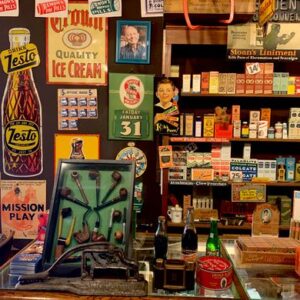
Inside Ruddy’s General Store

Ruddy’s General Store

This store is a recreation of a 1930s general store, where proprietor, Jim Ruddy has assembled a collection of nearly a century of Americana.  Items that he’s collected are in their original packaging and a majority of them hold their original contents.  I already hate shopping, but shopping for things you can’t actually buy or use is out of my ‘fun zone’.

Volkswagen Spider

This former auto repair shop has a 28-foot tall, metal spider, made from old Volkswagen Beetle parts.  The property was once the Hole in the Wall Welding Shop, and now is just called the Hole in the Wall.  The structure is adorned with cacti and metal spider webs.  If this is as bad as it looks, I’d have to have a ‘Hole in my Head’ to spend any time looking at a giant, metal Volkswagen spider.

Babies

The Naked Bridge

Also known as the ‘Bridge of Thighs’, it is a 140-foot overpass created in 2003 at a cost of $500,000, so people could walk naked across this bridge.  There are five-foot canvas panels along the bridge to ensure that only the heads of crossing nudists are seen and thus prevent fender benders from happening on the street below.  Yeah, that’s what I really go to the desert for, to see senior citizens walking across a bridge naked!

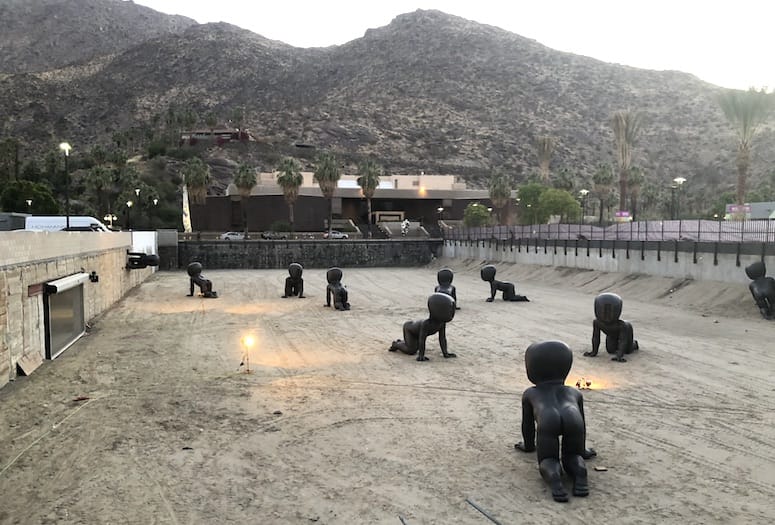
The Babies

These 10 sculptures of babies appearing to crawl in a sand pit are found in the Palm Springs Museum courtyard.  They are intended to be a statement on the negative influence of big tech and data in our lives.  These babies have no faces, rather a ‘bar code’ appears in place of their face.  With any luck, my GPS won’t be able to find this creepy place.

Shiprock

Where’s the Spanish galleon?

According to tourist information, “Shiprock gained its name from its uncanny resemblance to a Spanish galleon, but no matter what photo I pulled up, and there are plenty, I never saw any resemblance to a Spanish galleon.  It sits at the bottom of a prehistoric tropical sea that existed over 250 million years ago.   ‘Uncanny resemblance’???  No matter how I looked at this heap of rock, I just couldn’t ‘see’ the ship, maybe it’s better in real life – I’ll never know!  What I do know about Spanish galleons, is that when Columbus discovered America, he got over 3,000 miles to the galleon!  Rim shot!!

Romance Theater

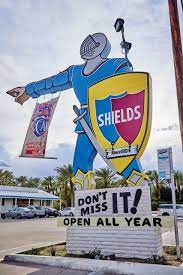
Shield’s Date Knight

Floyd and Bess Shields opened the Shields Date Garden in 1924; finding that date competition was very strong in the Coachella Valley, they created a slide show with a recorded sound track and called it, The Romance and Sex Life of a Date’ and put a mammoth Knight in Armor just off Highway 111 to direct people to their date farm.  It’s open all year – don’t miss it!  Sorry, not my idea of a ‘date night’!

So, if this is what I’ve been missing for the past 29 years, I think I’ll continue to play golf, enjoy fine dining and have a rum and coke while I watch the sun sink behind Mt. San Jacinto from the deck of our condo.  But perhaps you’ve found something here to make your next trip to the desert a unique one.

You’re welcome!